Rhinoplasty in Bangkok, Thailand
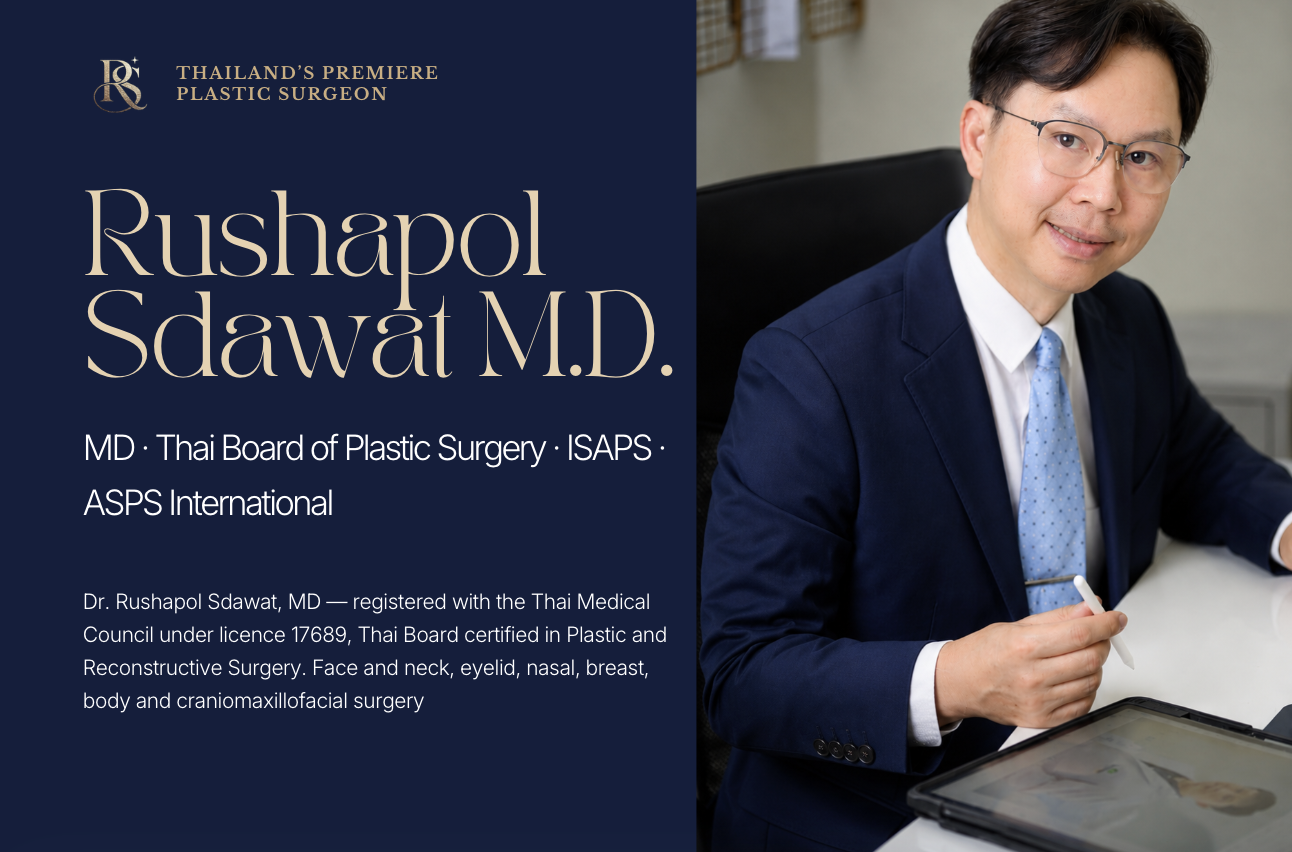
Dr. Rushapol Sdawat, M.D. — Thai Board-Certified Plastic & Reconstructive Surgeon
Preservation and structural rhinoplasty | Trained with Dr. Baris Cakir, Istanbul (2023) | Intrarat Hospital, Bangkok
Rhinoplasty reshapes the bone and cartilage framework of the nose, and the result you see is that framework as transmitted through your own skin. Dr. Rushapol Sdawat performs both preservation and structural rhinoplasty in Bangkok, choosing the technique from the nose in front of him rather than using one approach for everybody. This is the treatment page; for the full discussion of technique, evidence and limits, read Preservation rhinoplasty explained: what it changes and who it suits.
Preservation rhinoplasty
Conventional, or structural, rhinoplasty removes a dorsal hump by cutting bone and cartilage from the top of the nose, which opens the roof; the roof must then be rebuilt with osteotomies and usually spreader grafts. Preservation rhinoplasty inverts the logic: the dorsum is left intact as a single unit and lowered as a whole from underneath, by removing a strip of septal cartilage beneath it and releasing the bony sidewalls (a push-down or a let-down). The natural dorsal aesthetic line, the keystone area and the internal nasal valve are left undisturbed, and there is no open roof to rebuild.
Dr. Rushapol trained in preservation rhinoplasty directly with Dr. Baris Cakir in Istanbul in 2023, completed a rhinoplasty fellowship in Plovdiv, Bulgaria, in the same year, and attended the preservation rhinoplasty symposium in Nice and rhinoplasty symposia in Stuttgart and Berlin. He uses a preservation approach in a substantial minority of primary rhinoplasties and a structural approach in the rest.
Preservation versus structural rhinoplasty
| Preservation (dorsal) | Structural (reduction) | |
|---|---|---|
| The hump is | Lowered as an intact unit | Resected, then the roof rebuilt |
| Open roof created | No | Yes |
| Spreader grafts | Usually unnecessary | Usually necessary |
| Internal nasal valve | Left undisturbed | Reconstructed |
| Dorsal irregularity / inverted-V risk | Lower | Higher; a recognised risk |
| Main failure mode | Hump persistence or recurrence | Irregularity, over-resection, saddling |
| Deviated septum | Constrained; the septum is load-bearing | Straightforward |
| Very large humps / revision noses | Limited / usually unsuitable | Well suited / the standard approach |
| If it fails on the table | Convertible to structural | — |
A preservation approach that is not achieving the intended dorsal height can be converted to a structural one during the operation. The reverse is not true, which is why the surgical plan always includes what happens if preservation is not working.
Noses preservation does not suit
Dr. Rushapol does not attempt a preservation approach on very large humps (the base runs out of room and the hump is lowered but too wide, or reappears); significantly deviated or S-shaped septums (correcting the deviation and preserving the dorsum pull in opposite directions); marked bony asymmetry (setting down a crooked pyramid gives a lower crooked pyramid); most revision noses (the structures preservation depends on have usually been removed); and anyone wanting a large, sculpted transformation. Preservation is at its best producing a refined version of the nose you already have.
Thick skin is a hard ceiling
The visible shape of the nose is the cartilage framework as seen through the skin envelope. Thick, sebaceous skin bridges fine contours and reads as a soft, rounded tip regardless of what has been built underneath, and it holds swelling for far longer: in thin-skinned patients the nose looks close to final at six months, in thick-skinned patients the tip may still be settling at twelve to eighteen months. Careful defatting, stronger tip support and longer taping help; none of them changes the ceiling. Dr. Rushapol tells patients where their ceiling is at consultation, and some reasonably decide not to proceed.
Silicone, septal, ear and rib cartilage
| Silicone implant | Septal cartilage | Ear (conchal) cartilage | Rib (costal) cartilage | |
|---|---|---|---|---|
| Quantity | Unlimited | Limited, often insufficient | Moderate | Abundant |
| Donor site | None | None additional | Small scar behind the ear | Chest scar, days of pain |
| Best for | Modest dorsal augmentation | Spreader and strut grafts, tip | Alar rim and tip contouring | Major augmentation, revision, saddle nose |
| Warping | No | Minimal | Minimal | Real risk; reduced by carving technique |
| Long-term extrusion | Recognised risk, rises with time | No | No | No |
| Infection risk | Higher (foreign body) | Low | Low | Low |
Where there is a free choice, Dr. Rushapol uses the patient's own septum first, ear second, and rib where the volume required cannot be found elsewhere. Silicone is acceptable for modest dorsal augmentation in a patient who understands it is not a lifetime device; he does not use silicone in the tip, where the skin is thinnest and extrusion most likely.
What the evidence shows
A 2024 systematic review and meta-analysis in Plastic and Reconstructive Surgery – Global Open pooling 19 studies and 1,523 patients found no statistically significant difference in patient satisfaction between dorsal preservation and component hump reduction, with revision reported at roughly two per hundred patients. A 2024 worldwide survey of 117 rhinoplasty surgeons found no significant difference in revision rates between technique types; the most cited concern was hump persistence or recurrence. Read honestly, preservation is a good operation giving comparable satisfaction to structural rhinoplasty, not a demonstrably superior one.
Risks and complications
Bleeding, sometimes needing packing; septal haematoma, which must be drained; septal perforation; infection, which in a nose containing an implant may mean removing the implant; persistent nasal obstruction, which can be worse than before; loss of tip support over years; saddling from over-resection; a polly beak; visible dorsal irregularities, particularly through thin skin; tip numbness, usually temporary; prolonged swelling; rarely, changes to smell. Rhinoplasty has the highest revision rate in aesthetic facial surgery, and no technique or surgeon eliminates that. Sudden severe increasing nasal pain with septal swelling and complete blockage, bleeding that will not stop after 15 minutes of firm pinching, fever above 38.5 °C with spreading facial redness, or chest pain or breathlessness after a flight are emergencies: go to a hospital immediately.
Cost
Published indicative prices, confirmed at booking: open rhinoplasty A$4,800 (฿109,000); open rhinoplasty with or without septoplasty A$8,300 (฿190,000); reduction rhinoplasty with or without septoplasty A$9,600 (฿220,000). Which tier applies depends on the complexity of your nose and is determined at consultation, not by choosing from a menu. Your itemised quotation follows consultation.
Stay and recovery
Book so that a delay is possible: if Dr. Rushapol is not happy with your nose on day seven, he will want you in Bangkok on day nine. Thin-skinned noses look close to final at six months; thick-skinned tips may still be settling at twelve to eighteen months. Read: flying after surgery: how long is safe?
Before and after
Photographs are of consenting patients and are not retouched. Individual results vary. View before and after results.
Frequently asked questions
Is preservation rhinoplasty better than structural rhinoplasty?
Not demonstrably. A 2024 meta-analysis of 1,523 patients found no significant difference in patient satisfaction between the two. Preservation avoids the open roof and spreader grafts and keeps the natural dorsal line, but has its own failure mode, hump persistence or recurrence, and does not suit every nose.
Which noses are not suitable for preservation rhinoplasty?
Very large humps, significantly deviated or S-shaped septums, marked bony asymmetry, most revision noses, and anyone wanting a large sculpted transformation.
Will my tip be sharply defined?
Only if your skin allows it. Thick, sebaceous skin bridges fine contours and reads as a softer, rounder tip whatever is built underneath. Your skin thickness and what it means for your tip are discussed at consultation.
Does Dr. Rushapol use silicone implants?
For modest dorsal augmentation in a patient who understands it is not a lifetime device, yes. He does not use silicone in the tip. Where there is a free choice he uses the patient's own septum first, ear cartilage second, and rib where more volume is needed.
How much does rhinoplasty cost in Bangkok with Dr. Rushapol?
Published indicative prices are A$4,800 for open rhinoplasty, A$8,300 for open rhinoplasty with or without septoplasty and A$9,600 for reduction rhinoplasty with or without septoplasty. The tier is determined at consultation and confirmed at booking.
Request a consultation
Ask any rhinoplasty surgeon four things: what is my skin thickness and what does it mean for my tip; which technique do you plan to use, and what is your plan if it is not working intraoperatively; what material will be inside my nose in twenty years; and what happens, practically and financially, if I need a revision after I have flown home. Consultations are in person in Bangkok or by video; you receive a written treatment plan and an itemised quotation.
Medically reviewed by Dr. Rushapol Sdawat, M.D., Medical Council of Thailand licence No. 17689. Last reviewed: 7 September 2026. This page is general information, not medical advice. All surgery carries risk; individual results vary and are not guaranteed. Suitability can only be determined after consultation and examination.
