

Blepharoplasty (Eyelid Surgery) in Bangkok, Thailand
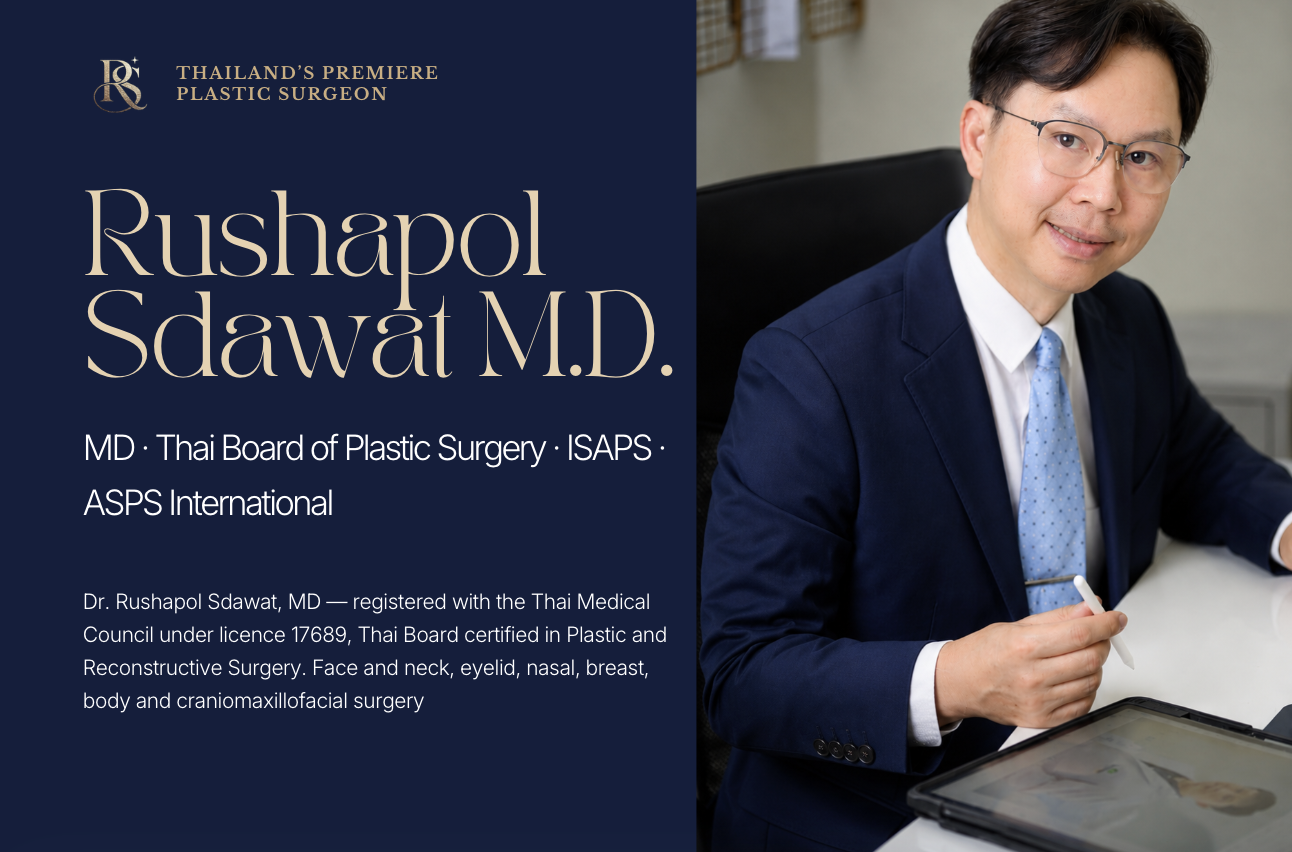
Dr. Rushapol Sdawat, M.D. — Thai Board-Certified Plastic & Reconstructive Surgeon
Upper and lower eyelid surgery | Intrarat Hospital, Bangkok | Often combined with a facelift or brow lift
Upper and lower blepharoplasty share a name and almost nothing else: different anatomy, different incisions, different anaesthetic, different recovery and different complications. Confusing them is the commonest reason patients arrive asking for the wrong operation. This is the treatment page for eyelid surgery with Dr. Rushapol Sdawat in Bangkok. For his full guide, read Upper vs lower blepharoplasty: which eyelid surgery do you actually need?
Upper blepharoplasty
An upper blepharoplasty removes a measured ellipse of skin from the upper lid, sometimes with a strip of orbicularis muscle and a small amount of medial fat. The incision sits inside the natural lid crease. It takes about an hour for both sides, is very often performed under local anaesthetic with the patient awake, and bruising is usually settled enough for normal life within two weeks.
Four things can produce a heavy upper lid and they need different answers: dermatochalasis (genuine excess skin, which is what upper blepharoplasty is for), medial fat pad herniation, brow descent (forehead skin that has migrated down, which cutting lid skin does not fix and can make worse), and blepharoptosis (a low lid margin from a stretched levator muscle, which is a lid-lifting problem, not a skin-removing one). About half of the upper lids Dr. Rushapol assesses have two of the four. Read: hooded eyes: brow lift or blepharoplasty?
Lower blepharoplasty
The problem in the lower lid is almost never excess skin alone. It is usually herniation of the orbital fat pads through a weakening septum, combined with descent of the cheek and hollowing at the tear trough. Correcting that means working at the orbital rim, either from behind the lid through the conjunctiva or through a fine incision just under the lashes. It is a longer operation, usually under general anaesthesia or sedation, and bruising takes two to four weeks.
A simple test: look in a mirror, then lie down and look again. If your under-eye bags soften when you are flat, you are looking at fat that moves with gravity, which may need repositioning over the rim. If the shadow stays, you are largely looking at a hollow, which needs volume added, and removing anything will make it worse. The amount of lower lid skin that can safely be removed is usually two or three millimetres. Read: eye bag surgery and fat repositioning.
Upper versus lower at a glance
| Upper blepharoplasty | Lower blepharoplasty | |
|---|---|---|
| Main target | Excess skin, sometimes medial fat | Herniated orbital fat, tear-trough hollowing, lid–cheek junction |
| Incision | Inside the upper lid crease | Behind the lid (transconjunctival) or just below the lashes |
| Anaesthetic | Usually local, patient awake | Usually general or sedation |
| Operating time | 45 to 60 minutes | 60 to 120 minutes |
| Bruising | Mostly gone by 10 to 14 days | More marked; 2 to 4 weeks |
| Back at work | 10 to 14 days | 2 to 3 weeks |
| Defining complication | Over-resection causing lagophthalmos | Ectropion or lid retraction |
| Usually combined with | Brow lift | Midface support or fat grafting |
How you are assessed
Dr. Rushapol holds the forehead still, because everything else is unreliable until he does. He checks lid margin position against the iris, looks for a crease, measures levator function, pulls the lower lid and watches how fast it returns, and asks about dry eye, contact lenses and thyroid disease before looking at a photograph. Then he tells you which upper lid problems you have and in what proportion, whether your lower lid issue is fat, hollow or descent, and whether the operation that would help you most is the one you came in asking for. Often it is not; sometimes it is a brow lift; occasionally it is nothing at all.
Who is declined
Dr. Rushapol declines eyelid surgery in several situations: active thyroid eye disease not stable for at least six months; significant untreated dry eye, or laser refractive surgery within six months; unrecognised ptosis where the patient wants only skin removed; a lax lower lid where the patient refuses canthal support; and anyone flying home too soon.
Risks and complications
Dry eye is not a footnote. A ten-year single-surgeon review of 892 blepharoplasty cases found dry eye symptoms in about a quarter of patients and swelling of the conjunctiva in a similar proportion, with higher rates when the lid does not fully close afterwards and when upper and lower lids are done in the same sitting. If you already have dry eye, tell your surgeon before anything else. Other risks include prolonged swelling and bruising, a visible crease scar, early asymmetry (common, usually settling by three months), suture cysts, infection, haematoma and lid margin numbness. The complications that matter most are over-resection of upper lid skin causing lagophthalmos, and lower lid retraction or ectropion; both are very difficult to reverse because skin removed from an eyelid cannot be replaced with anything that looks like eyelid skin. Sudden severe pain behind the eye, a hard bulging eye or loss of vision after surgery is an emergency requiring a hospital immediately.
Cost
Published indicative prices at Intrarat Hospital, confirmed at booking: double eyelid surgery under local anaesthetic A$1,400 (฿32,000); upper and lower eyelid surgery under general anaesthetic A$4,800 (฿110,000). Indicative ranges for eyelid surgery added to a facelift are in the practice's facelift in Thailand guide. Your itemised quotation follows consultation.
Before and after


Photographs above show eyelid surgery performed together with facelift procedures; results shown are of combined operations.
Photographs are of consenting patients and are not retouched. Individual results vary. View before and after results.
Frequently asked questions
Is my problem the upper lid or the brow?
Hold your forehead still with one palm, then lift the tail of one eyebrow two or three millimetres with a fingertip. If the hooding largely disappears, a significant part of your problem is brow position. If the lid skin still hangs, it is lid skin.
Do I have bags or hollows under my eyes?
Look in a mirror standing, then lying flat. Bags that soften when flat are fat; a shadow that stays is largely a hollow, which needs volume rather than removal.
Is upper blepharoplasty done awake?
Very often, under local anaesthetic. Lower blepharoplasty is usually performed under general anaesthesia or sedation.
Can upper and lower lids be done together?
Yes, and they often are alongside a facelift, but doing both in the same sitting is a recognised risk factor for dry eye afterwards, which is discussed at assessment.
How long do I stay in Bangkok?
Plan around two weeks when eyelid surgery is combined with a facelift, in line with the practice's stay guidance for facial surgery; an in-person review clears you to fly. The stay for eyelid surgery alone is confirmed for your specific plan at consultation.
Request a consultation
Consultations are in person in Bangkok or by video; you receive a written treatment plan and an itemised quotation.
Medically reviewed by Dr. Rushapol Sdawat, M.D., Medical Council of Thailand licence No. 17689. Last reviewed: 7 September 2026. This page is general information, not medical advice. All surgery carries risk; individual results vary and are not guaranteed. Suitability can only be determined after consultation and examination.
