

Facial Fat Grafting in Bangkok, Thailand
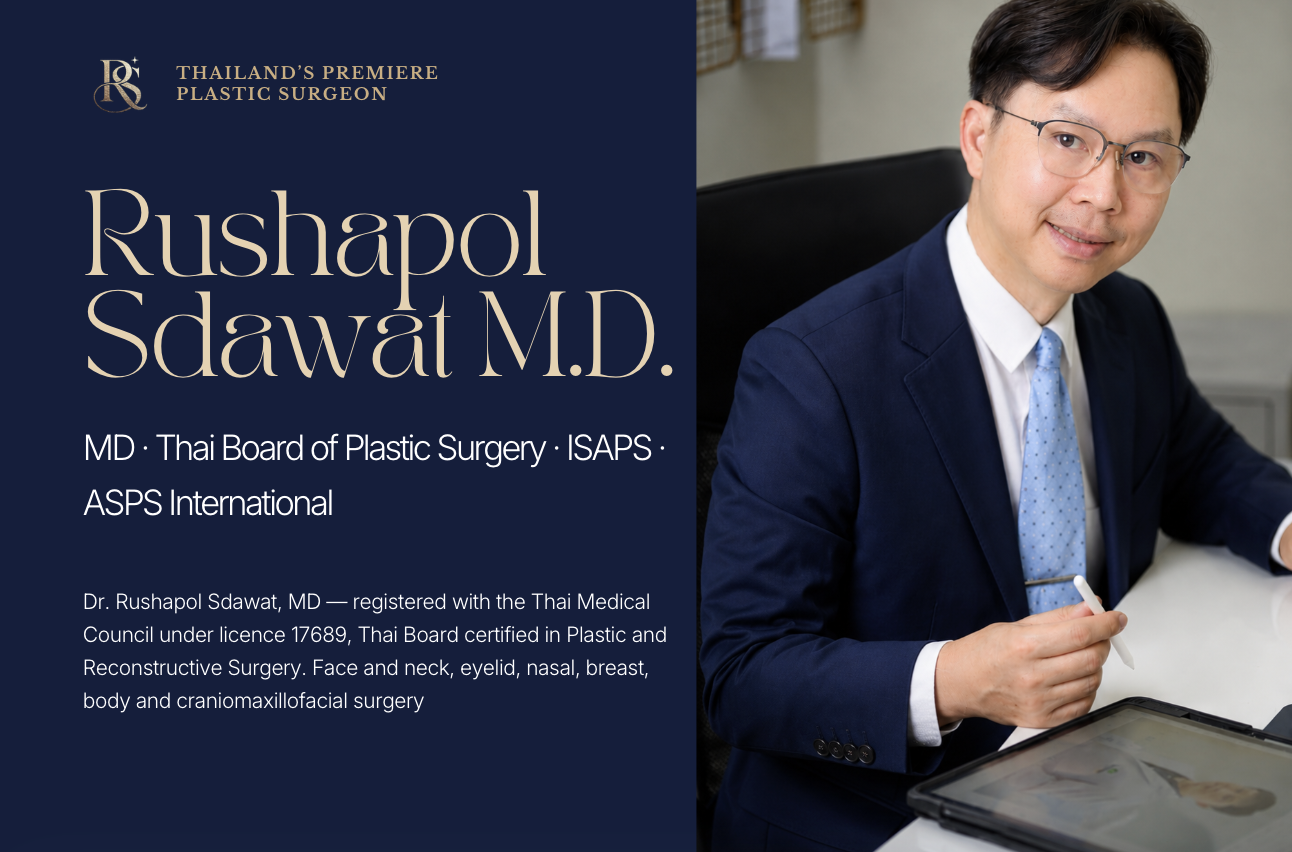
Dr. Rushapol Sdawat, M.D. — Thai Board-Certified Plastic & Reconstructive Surgeon
Fat transfer to the face | Usually combined with a deep plane facelift | Intrarat Hospital, Bangkok
A facelift addresses sagging; fat grafting addresses deflation, the volume the face has lost with age that no amount of lifting can put back. Facial fat grafting takes a small amount of your own fat, usually from the abdomen or thighs, prepares it and injects it in fine layers into the temples, cheeks, under the eyes, around the mouth and along the jawline. This is the treatment page for facial fat grafting with Dr. Rushapol Sdawat in Bangkok; for the full guide, read Fat grafting with a facelift: when lifting is not enough.
The part a facelift does not fix
From the thirties onward the fat compartments of the face shrink, particularly in the temples, upper cheeks, around the eyes and beside the mouth, and the underlying bone loses volume around the eye sockets and jaw. The result is a face that looks tired at rest: hollow temples, flattened cheeks, a shadow under the eyes, a deepened groove from nose to mouth. A facelift treats the "down" of ageing but not the "out" that has been lost. The over-lifted, wind-swept face is often one where a surgeon tried to solve a volume problem by pulling harder. A deep plane facelift repositions the cheek fat compartments and restores much of the mid-face fullness without grafting; when the fat has genuinely shrunk rather than only descended, fat is added.
Areas treated
| Area | Purpose |
|---|---|
| Temples | Soften a narrow, skeletal upper face with small volumes |
| Upper cheek and cheekbone | The commonest area; restoring the cheek's curve lifts the visual centre of the face |
| Lower eyelid and tear trough | The hollow that makes people look tired; very fine placement needed |
| Nasolabial folds and marionette lines | Softened, not erased; over-filling is avoided |
| Around the mouth | Fine vertical lines; for lip volume specifically Dr. Rushapol more often uses dermal graft (lip augmentation with dermal graft) |
| Jawline and chin | Small amounts restore definition where bone has receded |
How it is performed
Fat is harvested first with a fine blunt cannula through a tiny incision in the abdomen, flank or inner thigh; only tens of millilitres are needed. It is processed by gentle centrifuging, filtering or washing to separate intact fat cells from blood, oil and fluid. After the facelift's deeper layer has been repositioned and the skin re-draped, the fat is injected with fine cannulas in very small amounts, threaded through the tissue in many thin passes rather than placed as a lump, because each small parcel must sit close enough to living tissue to acquire new blood vessels. When the main problem is volume with little sagging, fat grafting is sometimes performed alone under sedation; it can also be added to a neck lift or eyelid surgery.
Fat graft survival
Not all of the fat survives. Cells that never acquire a blood supply are absorbed over the first few months; the fat that survives is permanent and behaves like the rest of the fat in your face, changing with your weight. Published figures suggest a moderate majority typically survives in experienced hands, but the range is broad and no figure is promised to any individual patient. Slightly more fat is placed than the final result requires, so the face looks fuller in the first weeks than it finally will; judge the result at three to six months. Occasionally a second, smaller session a year or more later is worthwhile.
Fat grafting versus dermal filler
| Fat grafting | Dermal filler (hyaluronic acid) | |
|---|---|---|
| Material | Your own fat | Manufactured gel |
| Duration | Surviving fat is permanent | Typically 6 to 18 months, then repeated |
| Setting | Surgery, usually under general anaesthesia | Clinic, numbing only |
| Volume | Larger volumes, whole-face rejuvenation | Smaller volumes, targeted areas |
| Reversibility | Not easily reversed | Can be dissolved with an enzyme |
| Main downside | A proportion is absorbed; result takes months to settle | Cost and repetition over years; can look heavy if overused |
Who should not have fat grafting
Patients with a naturally full or heavy face, where adding fat makes it heavier; patients who are significantly overweight or whose weight fluctuates, because grafted fat responds to weight change; anyone using nicotine, which reduces the chance of grafted fat acquiring a blood supply; patients expecting millimetre precision, who are better served by filler or by nothing; and very thin lower-eyelid skin, where any irregularity shows and the area is avoided or treated very conservatively.
Recovery
Recovery is broadly the same as from a facelift alone, with more swelling in the first two weeks and a small harvest site on the abdomen or thigh that is bruised and a little sore for about a week. Grafted areas must not be pressed or massaged for the first few weeks. Length of stay in Bangkok is the same as for a facelift alone. Read: facelift recovery timeline and how long to stay in Bangkok after a facelift.
Risks
The specific risks of grafting are lumpiness, asymmetry, over- or under-correction and, rarely, small cysts where fat has not survived, in addition to the risks of the facelift itself. Serious complications are rare when fat is placed carefully in small amounts.
Cost
Fat grafting is usually quoted as part of a combined facelift; your itemised quotation follows consultation. Indicative facelift ranges are on the deep plane facelift page.
Before and after
Photographs on this site are of consenting patients and are not retouched. Individual results vary. View before and after results.
Frequently asked questions
Does every facelift need fat grafting?
No. A face that has sagged but kept its volume, or a naturally full face, is better served by the facelift alone. Fat grafting is for faces that have deflated as well as descended, decided case by case at assessment.
How much of the transferred fat survives?
A proportion is always absorbed in the first few months. In experienced hands a moderate majority typically survives, but the range is broad, so no figure is promised. The fat that survives is permanent.
Can fat grafting replace a facelift?
When the main problem is volume loss with little sagging, fat grafting alone can be very effective. It does not lift jowls, tighten the neck or remove loose skin; adding fat without lifting to a sagging face makes it heavier, not younger.
Will the grafted fat change if I gain or lose weight?
Yes. Surviving fat behaves like the rest of the fat in your face. Stable weight after surgery gives the most predictable result.
How long before I see the final result?
The face is fuller than final in the first few weeks. Most absorption happens over three months; judge the result at six months.
Request a consultation
Consultations are in person in Bangkok or by video; you receive a written treatment plan and an itemised quotation.
Medically reviewed by Dr. Rushapol Sdawat, M.D., Medical Council of Thailand licence No. 17689. Last reviewed: 7 September 2026. This page is general information, not medical advice. All surgery carries risk; individual results vary and are not guaranteed. Suitability can only be determined after consultation and examination.
