Hooded Eyes: Do You Need a Brow Lift or Eyelid Surgery?
By Dr. Rushapol Sdawat, MD — Thai Board-certified Plastic and Reconstructive Surgeon, Medical Licence No. 17689
Last reviewed: Aug 25,2026
You have caught yourself lifting your eyebrows to read a menu. You do it without noticing, and if you look carefully at your own forehead in a photograph you will find horizontal lines that were not there five years ago — not from expression, but from holding your brows up all day so that your eyes can see out from under them.
That habit is the single most useful piece of information about your face, and almost nobody asks about it. It tells you that your frontalis muscle has been recruited to compensate for something, and that whatever you are seeing in the mirror is not your true starting position.
Which matters enormously, because the two operations offered for hooded eyes do opposite things at the brow. One of them, performed on the wrong patient, makes hooding worse.
Hooding is a description, not a diagnosis
"Hooded eyes" describes an appearance: tissue overhanging the upper eyelid, obscuring the crease, sometimes reaching the lashes. It says nothing about where that tissue came from.
It might be genuine excess eyelid skin — dermatochalasis — in which case removing it is the answer. It might be forehead and brow skin that has descended and is now sitting where eyelid skin used to be — brow ptosis — in which case removing eyelid skin treats the wrong tissue. It might be the lid margin itself sitting too low from a stretched levator aponeurosis — blepharoptosis — a third problem again. Most commonly it is a combination, in proportions that only an examination with the forehead immobilised can reveal.
Getting this wrong is not a cosmetic quibble. It determines whether you feel better or worse afterwards.
Where a brow is supposed to sit
There is no single correct eyebrow, and the fashionable shape changes every decade. But the anatomical reference points are stable.
In most women, the brow sits above the bony supraorbital rim, with a gentle arch whose highest point lies towards the outer third — roughly above the outer edge of the iris or the outer corner of the eye. In most men the brow is flatter and sits at, or barely above, the rim. Raising a man's brow into a female arch is one of the classic ways brow surgery goes wrong.
With age the brow descends, and it does not descend evenly. The tail of the brow drops first and drops furthest, because the outer third has no frontalis muscle beneath it to hold it up — frontalis fibres do not extend to the lateral brow — while the depressor muscles that pull the brow down do reach there. That asymmetry of forces is why hooding is so often worst at the outer corner.
The finger-lift test, and three others you can do at a mirror
Do these in even, front-on light. The critical instruction is to keep the forehead completely still, which is much harder than it sounds if you have spent years compensating.
The forehead-hold. Press one palm flat and firmly across your forehead so the eyebrows cannot rise, and open your eyes normally. This is your true baseline. Almost everyone is surprised by it. Judge everything else from here.
The finger-lift test. Still holding the forehead, place a fingertip just above the tail of one eyebrow and lift it two or three millimetres — not more, and not into a surprised expression. If the hood largely disappears and the lid crease reappears, a significant part of your problem is brow position. If the skin still hangs over the crease with the brow lifted, it is lid skin.
The lash-line check. With the forehead held, look straight ahead. If tissue is touching or resting on your lashes, that is a functional problem, not just an aesthetic one, and it may be worth having assessed at home in Australia rather than overseas — see below.
The rest-and-release test. Close your eyes, let your whole face go slack for ten seconds, then open your eyes without moving your forehead. If your brows visibly drop as your face relaxes, your resting brow position is lower than the one you present to the world.
None of this replaces examination. It does mean you can walk into a consultation and say "I think this is brow, not lid," and see whether the surgeon engages with that or talks past it.
Why cutting eyelid skin can lower the brow further
This is the mechanism the article exists to explain.
If your brow is descended, you have been unconsciously holding it up with frontalis for years. Remove upper eyelid skin, and the crowding above the lashes eases. Frontalis, no longer needed, stops working as hard. The brow settles down to its true resting position — which is lower than where you have been holding it. The hooding you thought had been removed partly reappears, now with less eyelid skin available to work with.
This is not theory. A systematic review and meta-analysis published in Aesthetic Plastic Surgery in 2023 examined brow position after upper eyelid surgery across 17 studies and found that brow height decreased significantly afterwards. The pooled mean drop was 1.45 mm (95% CI 0.87 to 2.07, P < 0.0001), varying by procedure: about 0.67 mm after simple blepharoplasty, 2.52 mm after double eyelid surgery, and 2.10 mm after ptosis correction. Notably, the amount of skin excised did not significantly predict the drop — this is about frontalis relaxing, not about how much was cut.
A millimetre and a half is not a catastrophe. But if your brow was already 4 mm low and you drop it a further 1.5 mm while removing the skin that was masking the problem, you have spent money to look, in your own words afterwards, "more tired."
Brow lift versus blepharoplasty compared
Endoscopic brow liftUpper blepharoplastyTreatsDescended brow, heavy lateral hood, deep forehead furrowsGenuine excess upper eyelid skinEffect on brow heightRaises itLowers it slightly (pooled mean 1.45 mm)IncisionsSeveral short incisions behind the hairlineInside the upper lid creaseVisible scarHidden in hairFine line in the creaseAnaestheticGeneral or deep sedationOften local, patient awakeOperating time1–2 hours45–60 minutesBruising and swellingMore; can track to the eyelids and look dramatic in week oneModerateBack to work2–3 weeks10–14 daysNumbness of the scalpCommon early, can persist monthsNot applicableNerve at riskFrontal (temporal) branch of the facial nerveNone majorLongevitySubstantial elevation retained at 1–2+ years, with early relapseLong-lasting, but the brow keeps descendingMedicare item possible?No — not for cosmetic brow liftSometimes, MBS 45617, strict criteriaFixes a low lid margin (ptosis)?NoNo — needs levator surgery
Lateral hooding is a different problem again
If your hooding is concentrated at the outer corner and your inner lid looks reasonable, you almost certainly have lateral brow descent rather than generalised excess lid skin — for the anatomical reason given above.
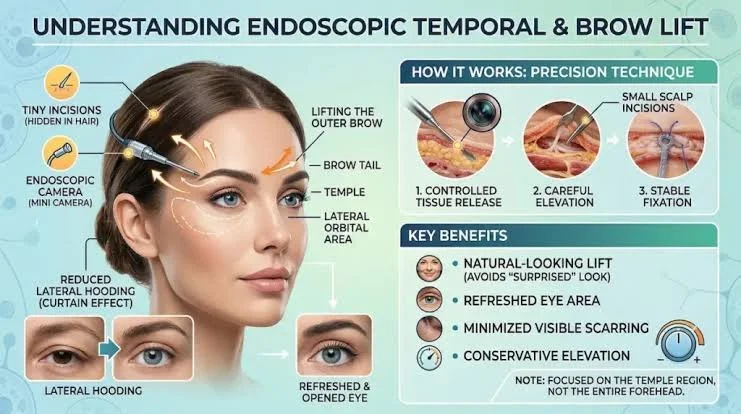
A standard upper blepharoplasty is poorly designed to fix this: the incision cannot be extended far enough laterally without a visible scar beyond the orbital rim, and pulling on lid skin does not lift a brow. What helps is elevating and fixing the lateral brow — endoscopically, through a temporal brow lift with a small incision in the temporal hair, or with an internal browpexy performed through the blepharoplasty incision, suspending brow soft tissue to the periosteum from below. Browpexy is a modest manoeuvre. It will not rescue a genuinely low brow, and it is often oversold as if it will.
When the answer is both, and when it is neither
Both is common, and there is a right order: address the brow first, then decide how much lid skin remains excess. If you plan both together, the blepharoplasty must be conservative, because the brow lift has already taken up some of the slack — which is why the lid is marked after the brow is elevated, not before. Removing a pre-planned amount of lid skin and then lifting the brow is how lids end up unable to close.
Neither is more common than clinic websites suggest. If your brow sits normally, your crease is visible, your lid margin is where it should be, and what you object to is a fine crepe texture of the eyelid skin, no operation available to you will improve that much — and both will leave scars. Some patients are best served by neuromodulator treatment of the brow depressors to gain a millimetre or two at the tail, some by skin quality treatments, and some by being told there is nothing worth operating on. I say the last regularly and it costs me bookings. It is still the right answer.
What an endoscopic forehead lift involves, and how long it lasts
Three to five short incisions are made behind the hairline. An endoscope is passed into the plane above or beneath the skull's periosteum, the forehead is released from the bone down to the orbital rims, the depressor muscles that pull the brow down are addressed, and the forehead soft tissue is elevated and fixed with sutures, absorbable devices or bone tunnels. No strip of scalp is removed and there is no long coronal scar.
Longevity is better than its reputation. A systematic review and meta-analysis in Aesthetic Surgery Journal in 2024 pooled 12 studies and 478 patients with objective measurements and found long-term brow elevation retained of 3.25 mm medially, 3.86 mm centrally and 4.35 mm laterally, with follow-up of one to two years in five studies and beyond two years in four. The same review noted an average loss of 2 to 3 mm within the first three months, with the lateral brow more prone to relapse.
That contains the honest message: you will lose a meaningful part of your result in the first three months, and this is normal rather than a failure. A brow that looks startled at week two usually looks right at month four. The mistake is to over-elevate at surgery in anticipation of relapse, which leaves a permanently surprised expression in the patients whose brows do not relapse.
The risks specific to brow surgery
These are different from eyelid risks and deserve their own list.
Injury to the frontal (temporal) branch of the facial nerve. It runs superficially across the temple, which is why this operation demands anatomical precision. Injury causes weakness or paralysis of frontalis on that side — an eyebrow that cannot be raised. Uncommon, usually temporary from traction or swelling, occasionally permanent.
Numbness and itching of the scalp from stretching of the supraorbital and supratrochlear nerves. Very common early, usually resolving over weeks to months, occasionally persisting — and a numb, itchy patch of scalp is genuinely irritating to live with.
Alopecia at the incision sites, sometimes permanent.
Hairline elevation. In a patient who already has a high forehead, this needs planning and sometimes a different incision design.
Over-elevation and a startled appearance, and asymmetry, common early and occasionally persistent.
Relapse and loss of fixation, discussed above.
Haematoma, infection, wound breakdown, and the general risks of general anaesthetic including venous thromboembolism, which matters if you are flying.
Lagophthalmos — combine a brow lift with an over-generous blepharoplasty and the eye may not close fully. This is the specific reason for conservative lid marking.
And a result you are technically fine with but emotionally disappointed by — a brow that is objectively better positioned and does not look like your face.
When to seek care
Emergency — go to a hospital immediately, day or night. Sudden severe pain behind an eye with rapidly increasing swelling, a tight forward-bulging eye, or any loss of vision or new double vision — this pattern after periorbital surgery suggests orbital haemorrhage and there is a short window in which pressure can be released. Rapidly expanding forehead or scalp swelling with severe pain, which suggests a haematoma under the flap. Fever with spreading facial redness. Chest pain or breathlessness during or after a flight, which is a possible pulmonary embolism and an emergency regardless of what surgery you had.
Same-day review. An eye that will not close fully. Increasing pain, redness or swelling after day three, when things should be improving. Pus or discharge from an incision. Fever above 38 degrees. A new inability to raise one eyebrow, which needs documenting properly even though it is usually temporary.
Within a few days. Persistent numbness or an itchy patch that is not settling. Visible asymmetry that is not improving by six weeks. Hair loss along an incision line. A gritty, watering eye not responding to lubricant drops.
If you are still in Bangkok, contact the hospital directly rather than whoever arranged the trip. If you are already home in Australia or New Zealand, present locally and bring your operation note — do not wait on a message to a surgeon in another time zone. Medicare does not cover overseas medical treatment and Australia has no reciprocal health agreement with Thailand; Australian private health insurance generally does not cover procedures performed overseas and may not cover follow-up at home; and standard travel insurance generally excludes medical tourism, with Smartraveller warning that evacuation can cost hundreds of thousands of dollars.
What it costs, and how I would decide with you
Our published prices are indicative in Australian dollars and Thai baht and confirmed at booking: Endoscopic Forehead Lift A$7,400 / ฿170,000; Double Eyelids under local anaesthetic A$1,400 / ฿32,000; Upper and Lower Eyelid under general anaesthetic A$4,800 / ฿110,000.
One caveat first. If tissue is resting on your lashes and obstructing your vision, MBS item 45617 exists in Australia for functional upper eyelid reduction under strict criteria, and Medicare will not pay a cent towards the same operation done in Bangkok. Get assessed at home before you book a flight. There is no equivalent item for a cosmetic brow lift.
In the room, I would hold your forehead still before doing anything else, because your presenting appearance is unreliable until I do. I would measure brow height against the supraorbital rim on both sides, do the finger-lift test with you watching in a mirror so you can see it too, check your lid crease and margin position, test levator function, and ask how often you catch yourself raising your brows.
Then I would tell you which of the three problems you have and in what proportion. Sometimes it is a brow. Sometimes a lid. Often both, and then it is a conversation about staging, cost and recovery. And sometimes I would tell you that your brow is where it should be and your lid skin is unremarkable, and decline to operate — a shorter consultation than either of us expected, and the honest one.
I am Thai Board-certified in Plastic and Reconstructive Surgery, Medical Licence No. 17689, board-certified by the Medical Council of Thailand since 2000 and a member of ISAPS since 2008.
I am a Thai Board-certified plastic and reconstructive surgeon practising at Intrarat Hospital, Bangkok — Medical Licence No. 17689, verifiable on the Medical Council of Thailand register at checkmd.tmc.or.th. Diploma of the Medical Council of Thailand certifying proficiency in Plastic Surgery (13 July 2000); full member of The Society of Plastic and Reconstructive Surgeons of Thailand since 2001; ISAPS member since 2008. International training includes the AO Foundation course in advances in rhinoplasty and facial osteotomy, the International Plastic Surgery Training Center (malarplasty and angle reduction) and the safe use of laser-assisted lipolysis at Goldman Butterwick & Associates, San Diego. I hold Thai specialist certification and am not registered with Ahpra or the Medical Council of New Zealand.
This article is provided for general information and education. It is not medical advice and cannot substitute for individual assessment by a qualified practitioner who knows your history. Surgery carries risk, including risk of serious complications and of outcomes that do not meet expectations. Results vary between patients.
