
Neck Lift in Bangkok: Fixing Jowls, Bands, and “Turkey Neck”
Neck Lift in Bangkok: Fixing Jowls, Bands and the "Turkey Neck"
A neck lift in Thailand costs roughly A$5,500–A$11,000 as a standalone operation and works by tightening the platysma muscle and removing deep fat — not by removing skin alone. For a board-certified surgeon in Bangkok, verify Thai Board of Plastic and Reconstructive Surgery certification and a Medical Council of Thailand licence. Dr Rushapol Sdawat (licence 17689) specialises in deep plane facelift and neck lift.
Key facts at a glance
| Detail | |
|---|---|
| Indicative cost — Thailand (standalone neck lift) | A$5,500–A$11,000 (NZ$6,000–NZ$12,000) |
| Indicative cost — Thailand (deep plane facelift + neck lift) | A$15,000–A$24,000 (NZ$16,500–NZ$26,500) |
| Indicative cost — Australia (neck lift) | A$10,000–A$25,000 (NZ$11,000–NZ$27,500) |
| Surgery time | 2–3 hours (isolated neck lift); 5–7 hours combined with a facelift |
| Anaesthetic | General anaesthesia in a licensed hospital theatre (occasionally sedation for a limited submentoplasty) |
| Hospital stay | 1 night, sometimes 2 if combined |
| Days needed in Thailand | 10–14 days isolated; 14–21 days if combined with a facelift |
| Compression garment | Continuous for 5–7 days, then nights for 3–6 weeks |
| Time off work | 2–3 weeks desk-based; longer for public-facing or physical roles |
| When you can fly home | Usually day 10–14, after sutures out and surgical review |
| How long results last | Typically 8–12 years of visible benefit; ageing continues |
These are indicative ranges only. Your final quote is confirmed after consultation and depends on your anatomy, technique and any combined procedures.
What actually causes an ageing neck?
"Turkey neck" is a single phrase covering at least six separate anatomical problems, and this is the reason so many neck procedures disappoint. Each cause needs a different operation. Treating the wrong one — or treating one and ignoring the rest — produces a neck that is different but not better.
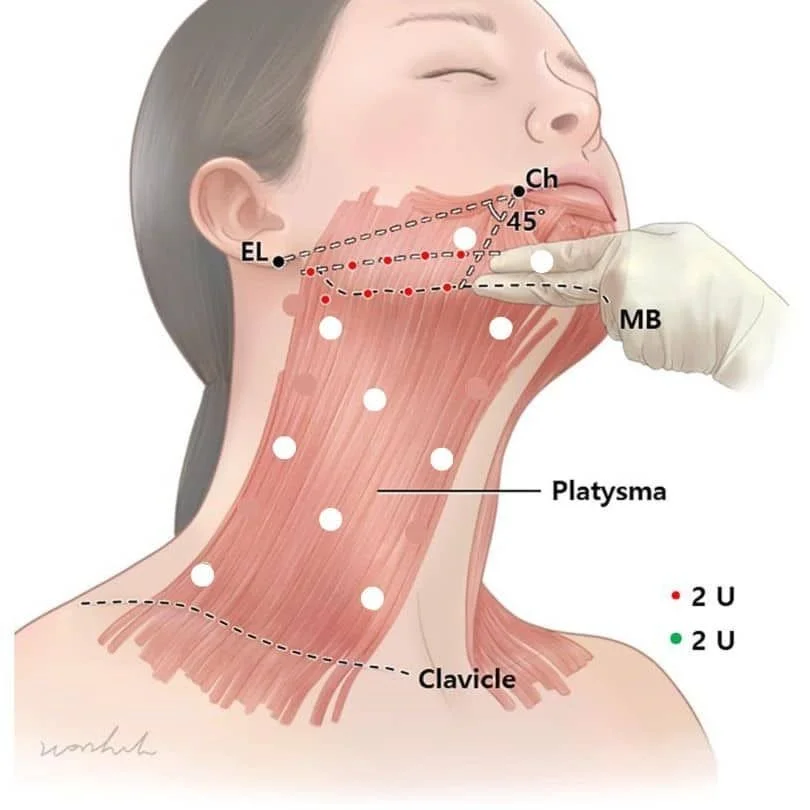
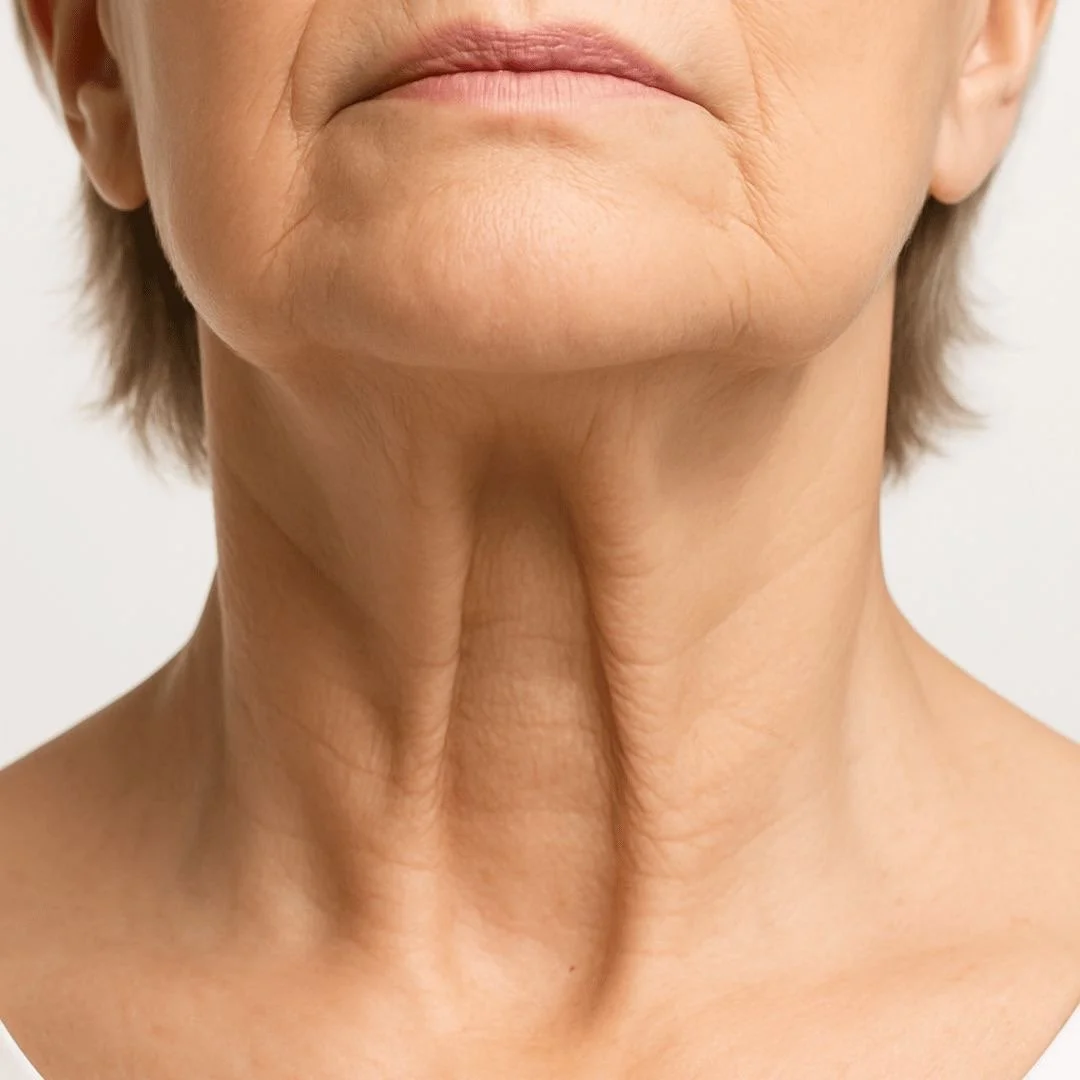
Platysmal banding. The platysma is a broad, thin sheet of muscle running from the collarbone up over the jawline. In youth its two halves meet loosely in the midline. With age the medial edges separate and thicken, and the free borders become visible as two vertical cords running from under the chin to the collarbone. They become more obvious when you talk, grimace or tense. No amount of skin tightening removes them, because they are muscle.
Subplatysmal fat. There is fat above the platysma and fat beneath it. The superficial layer is what liposuction reaches. The deep layer sits between the muscle and the deeper structures of the neck and is a common cause of a persistently full, blunted neck in otherwise slim people. It can only be addressed by opening the muscle.
Submandibular gland ptosis. The salivary glands sitting beneath the jawline can descend or simply be large, producing a soft bulge just below the mandibular border on each side. Patients often mistake this for fat. It is not, and liposuction there does nothing except thin the tissue covering the bulge and make it more visible.
Anterior digastric muscle bulk. The paired muscles running from chin to hyoid bone can be prominent enough to blunt the submental contour even after fat is removed.
Loss of cervicomental angle definition. The cervicomental angle is the crease between the underside of the chin and the front of the neck. A well-defined neck has a crisp angle — commonly cited in the region of 90 to 105 degrees — with a visible jawline above it. It is flattened by any combination of the above, and it is also limited by fixed anatomy: a low-set or anteriorly positioned hyoid bone, or a short, weak chin, caps how much definition is achievable no matter how well the operation is performed.
Skin laxity. Genuine excess skin, with reduced elastic recoil, that will not shrink back after the deeper work is done. This is the only element a skin-based procedure treats — and in patients under about 45 it is often the least significant of the six.
Jowls, incidentally, are not a neck problem at all. They are the descent of facial fat and the SMAS layer over the jawline, tethered by the mandibular ligament. That distinction matters enormously when deciding what operation you need.
Why doesn't liposuction alone fix most necks after 45?
Submental liposuction is a genuinely good operation for the right patient: someone in their twenties, thirties or early forties with a full neck, strong skin elasticity, no visible banding and fat that sits above the muscle. In that patient, removing the fat lets the skin retract and the angle appears.
Beyond about 45, three things usually change at once. Skin elasticity falls, so the skin no longer retracts into the space you have created. The platysma has already separated in the midline, so removing the fat that was camouflaging the bands makes them more visible. And a meaningful proportion of the fullness sits beneath the muscle, where a cannula cannot go.
The result is the outcome that brings a lot of patients to a second surgeon: a neck that is thinner but looks older, with sharper cords, a slightly hollow, skeletonised appearance in places and loose skin hanging over an improved deep contour. Removing fat is not the same as building a contour.
What is a platysmaplasty — and what's the difference between corset and lateral?
Platysmaplasty means surgically repositioning or tightening the platysma. There are two families of technique, and good necks usually need both.
Anterior (corset) platysmaplasty. Through a 3–4 cm incision in the crease under the chin, the surgeon exposes the medial borders of the platysma, trims or scores them where needed, and sutures the two halves together in the midline with a continuous running suture — the "corset". This re-creates a midline sling that supports the deep structures and abolishes the vertical bands. It is the only reliable way to treat true anterior banding, and it is also the access route for all deep neck work.
Lateral platysmaplasty. Performed through the facelift incisions in front of and behind the ear. The lateral border of the platysma is dissected, elevated on a vertical or oblique vector and fixed to the mastoid fascia and the sternocleidomastoid fascia. This is what actually produces the upward pull along the jawline and the posterior redraping of neck skin.
An anterior corset alone tightens the midline but does nothing to lift the jawline or redrape lateral skin. A lateral suspension alone lifts the sides but leaves midline bands untouched. In a patient with both problems, doing only one is the single most common reason a neck lift underperforms.
What is "deep neck" work and who needs it?
Deep neck contouring means everything performed after the platysma has been opened in the midline: removal of subplatysmal fat, partial reduction of the anterior digastric muscles, and — in carefully selected cases — partial reduction of a ptotic submandibular gland.
It is the difference between a neck that is tighter and a neck that has a genuine, sculpted angle. It is also where the operation becomes technically demanding and where the risk profile rises. The facial artery and vein, the marginal mandibular nerve and the hypoglossal nerve all sit in this territory. Submandibular gland reduction in particular is a debated manoeuvre: it can produce a dramatic improvement in a bulging jawline contour, and it carries real risks of bleeding, salivary collection and nerve injury. A surgeon who offers it to everyone, and a surgeon who refuses to discuss it at all, are both worth questioning.
Not everyone needs deep neck work. Patients with a good hyoid position, modest subplatysmal fat and no glandular ptosis get an excellent result from a corset platysmaplasty plus lateral suspension.
Do I need a neck lift, a submentoplasty, or a full facelift?
Submentoplasty is the limited version: a submental incision only, liposuction of the superficial fat, and a midline corset platysmaplasty. No pre-auricular or post-auricular incisions, so no skin redraping. It suits patients roughly 35–50 with good skin quality, real banding or fullness, and a jawline that is still crisp. Downtime is shorter and the scar is a single, well-hidden line under the chin.
A full neck lift adds incisions around and behind the ears so the neck skin can be lifted and redraped on a posterior-superior vector, plus lateral platysmal suspension. This is what you need once the skin genuinely has excess and the jawline has begun to soften.
A facelift with neck lift is required when the jawline itself has descended. And this is the honest, uncomfortable point most agency pages skip: an isolated neck lift in a patient with jowls will disappoint them. The platysma is continuous with the SMAS of the face; the jowl sits above the mandible, not below it. If you sharpen the neck and leave the jowls, you create a crisp cervicomental angle sitting beneath a soft, broken jawline, and the contrast draws the eye straight to the part that was not treated. Patients frequently describe the result as "something still looks wrong" without being able to name it.
Dr Rushapol Sdawat (Dr Dominic): "When a patient sits down and says they want just the neck done, I ask them to do three things before I say anything. Look straight ahead with the jaw relaxed. Then turn to profile and lift the chin. Then say 'eeee' and hold it. Those three views tell me almost everything. The relaxed frontal view shows me the jawline — if the mandibular border is broken by a jowl, the problem is above the jaw and no neck operation will fix it. The elevated profile shows me where the hyoid sits and how much of the fullness is deep, because a neck that stays blunt when the skin is stretched is a neck with subplatysmal fat, digastric bulk or a low hyoid, not a skin problem. And 'eeee' recruits the platysma, so the bands declare themselves — I can see whether they are two discrete cords I can corset, or a diffuse sheet that will need lateral suspension as well.
I also pinch. I lift the skin at the angle of the mandible and move it up and back on the vector I would actually use. If that manoeuvre corrects the jowl and the neck together, the patient needs a face and neck lift, and I tell them so. If the neck corrects and the face barely changes, an isolated neck procedure is honest surgery.
What I say to patients who insist on just the neck is this: I am happy to do it, but I want you to understand what you will be looking at. A beautiful neck under an untreated jawline is a mismatch, and once you notice it you cannot stop noticing it. Some patients hear that and add the face. Some are genuinely only troubled by the bands and are perfectly happy afterwards, and those patients do well. The mistake is not choosing the smaller operation — it is choosing it without being told what it does not do."
Am I a candidate?
| Your anatomy | Usually the right operation |
|---|---|
| Full neck, good skin recoil, no bands, under ~45 | Submental liposuction alone |
| Visible bands, modest fullness, crisp jawline, good skin | Submentoplasty (liposuction + corset platysmaplasty) |
| Bands plus loose neck skin, jawline still reasonable | Full neck lift: corset + lateral platysmaplasty + skin redraping |
| Blunt angle despite being slim; deep fullness | Deep neck contouring (subplatysmal fat ± digastric ± gland) |
| Jowls breaking the mandibular border | Facelift with neck lift — not a neck lift alone |
| Heavy skin excess, older male patient, scar-tolerant | Direct anterior neck lift, accepting a midline scar |
| Low-set hyoid, weak chin | Realistic expectation-setting; chin augmentation may be discussed |
You also need to be medically suitable: reasonable general health, blood pressure controlled, non-smoking for at least six weeks before and after (smoking is the strongest modifiable risk factor for skin-flap healing problems), stable weight, and off medications and supplements that increase bleeding as directed.
What is recovery actually like?
Days 0–2. One night in hospital. A supportive dressing or compression garment, sometimes a small drain removed the next morning. Swelling is at its most dramatic on days two and three. You will feel tight, and swallowing and turning your head feel restricted.
Days 3–7. Bruising migrates down onto the chest — this is normal and gravity-driven. The compression garment is worn continuously except for showering. Sleep propped at 30–45 degrees. Most patients are off strong analgesia within a few days.
Days 7–14. Sutures out, typically between day 7 and day 10. Bruising fading, swelling still obvious. The submental area feels firm, lumpy and numb — this is expected and is the healing tissue, not a bad result. Surgical review before flying, generally day 10–14 for an isolated neck lift.
Weeks 3–6. Garment reduced to nights. Most patients are socially presentable by week 3 with makeup for residual bruising, and comfortable in work settings by weeks 3–4. Light exercise resumes around week 3–4; heavy lifting and anything that raises blood pressure sharply, later.
Months 3–12. This is the part almost every website understates. The neck is the slowest area of the face to settle. Submental firmness and irregularity commonly persist for three to six months, and the final contour — the true definition of the angle — is usually not fair to judge until nine to twelve months. Numbness under the chin and around the earlobes resolves gradually over the same period, occasionally with small permanent patches.
How much does a neck lift cost in Thailand?
| Procedure | Thailand (AUD) | Thailand (NZD) |
|---|---|---|
| Submental liposuction alone | $2,000–$4,000 | $2,200–$4,400 |
| Submentoplasty (lipo + corset platysmaplasty) | $3,500–$7,000 | $3,800–$7,700 |
| Full neck lift (corset + lateral + skin redraping) | $5,500–$11,000 | $6,000–$12,000 |
| Deep plane facelift with neck lift | $15,000–$24,000 | $16,500–$26,500 |
For comparison, an Australian neck lift is commonly published at A$10,000–A$25,000 (NZ$11,000–NZ$27,500), and a face and neck lift at A$30,000–A$50,000. Medicare provides no rebate for neck surgery performed for ageing, and because private funds can only pay against MBS-listed items, there is no private benefit either. Medicare never covers surgery performed overseas.
Usually included in a Thai quote: surgeon's fee, anaesthetist, hospital theatre and one night's inpatient care, standard post-operative medication, compression garment, and in-country follow-up during your stay.
Usually excluded: flights, accommodation beyond the hospital stay, transfers, a support person's costs, pre-operative pathology if done at home, travel insurance covering medical complications, and any revision. Budget A$2,000–A$3,000 contingency for extra nights or changed flights.
For a practice-specific quote, request a consultation.
These are indicative ranges only. Your final quote is confirmed after consultation and depends on your anatomy, technique and any combined procedures.
About the surgeon
Dr Rushapol Sdawat, MD (Dr Dominic) — Thai Medical Council licence 17689. MD, Siriraj Medical School, Mahidol University (1992); Thai Board of General Surgery (1998); Thai Board of Plastic and Reconstructive Surgery (2000). fellowship in dermatologic laser surgery, Ramathibodi Hospital (2004); faculty instructor in plastic surgery 2000–2008; advanced facelift, rhinoplasty and blepharoplasty training in Korea, France, Bulgaria, Turkey and Germany (2022–2023). Outstanding Surgery Residency Award (1995), Phramongkutklao Hospital.
Member of the Medical Council of Thailand, the Thai Society of Plastic and Reconstructive Surgery and ISAPS (member since 2008). Board-certified in plastic surgery by the Medical Council of Thailand since 2000. Deep plane facelift and neck lift is his signature procedure. Practises in Bangkok (MedSanctuary, Intrarat Hospital), Samutsakorn (Ekkachai Hospital) and Nakhon Sawan (Sdawat Clinic).
Risks and honest limits
All surgery carries risk, and a neck lift is a real operation under general anaesthesia.
Marginal mandibular nerve injury. This branch of the facial nerve supplies the muscles that pull the lower lip down and out. It runs close to the surgical field along the jawline. Injury produces an asymmetric lower lip on full smiling or grimacing — the affected side does not depress properly. The great majority of cases are neuropraxia from stretch or swelling and recover over weeks to a few months. Permanent injury is uncommon but is a recognised complication, and it is the risk most worth understanding before you consent.
Contour irregularity. The most common aesthetic complication. Over-resection of subplatysmal fat without adequate platysmal repair can produce a hollowed, over-skeletonised submental area sometimes described as a "cobra neck" deformity. Uneven fat removal leaves palpable or visible steps. Some irregularity in the first months is normal healing; persistent irregularity may need revision.
Haematoma. The most common early complication, usually within the first 24 hours, more frequent in men and in patients with uncontrolled hypertension. It may require a return to theatre.
Other recognised risks. Great auricular nerve injury with earlobe numbness; persistent or recurrent platysmal bands; seroma; infection; skin-flap healing problems (markedly higher in smokers); hypertrophic or widened scarring; salivary collection or fistula if the submandibular gland is reduced; asymmetry; and anaesthetic risks including venous thromboembolism — a risk long-haul flying compounds, which is why the day 10–14 clearance exists.
Honest limits. A neck lift repositions muscle, removes fat and redrapes skin. It does not improve skin quality, sun damage, crepey texture or horizontal neck creases. It cannot create an angle your hyoid position will not allow. It does not treat jowls. And it does not stop ageing — the platysma continues to descend. Results vary between individuals and no outcome can be guaranteed. Suitability can only be determined by proper assessment.
How should I choose a surgeon for a neck lift in Bangkok?
- Confirm the qualification, not the adjective. You want the Thai Board of Plastic and Reconstructive Surgery and a Medical Council of Thailand licence number you can verify. "Cosmetic surgeon" and "aesthetic doctor" are not the same thing.
- Ask which specific manoeuvres are planned. A surgeon who can tell you whether they intend a corset platysmaplasty, a lateral suspension, both, and whether subplatysmal fat will be addressed, is a surgeon who has actually examined your neck.
- Ask directly whether you need the face too. If the honest answer is yes and you are told a neck lift alone will fix your jowls, that is a serious warning sign.
- Ask about submandibular glands. Whether they are contributing, and if reduction is proposed, what the surgeon's approach to the risks is.
- Look at profile photographs at 6–12 months, not 6 weeks, and with the chin in a neutral position. Elevated-chin "after" photos flatter every neck.
- Confirm where you will be operated on — a licensed hospital theatre with an anaesthetist, not a clinic room.
- Get the follow-up arrangement in writing before you pay a deposit: who reviews you at three, six and twelve months from Australia or New Zealand, and what the revision policy covers.
Frequently asked questions
Can a neck lift fix jowls?
Only partly. Jowls are facial fat and SMAS descending over the jawline, so they sit above the mandible, not in the neck. A lateral platysmal suspension improves the jawline slightly, but genuine jowl correction needs a facelift. If jowls are your main concern, a neck lift alone will not satisfy you.
Will liposuction alone fix my turkey neck?
Rarely after about 45. Liposuction only reaches fat above the platysma. If you have platysmal bands, subplatysmal fat or reduced skin elasticity, removing superficial fat can make bands more visible and leave loose skin. It remains an excellent operation for younger patients with good skin recoil and no banding.
How long do I need to stay in Thailand for a neck lift?
Plan 10–14 days for an isolated neck lift and 14–21 days if it is combined with a facelift. Sutures typically come out between day 7 and day 10, and a surgical review before flying is standard. Booking a shorter trip is the most common planning mistake international patients make.
How long do I wear the compression garment?
Typically continuously for the first 5–7 days, except when showering, then at night for a further 3–6 weeks. It controls swelling and helps the skin adhere to the newly contoured deep tissue. Instructions vary between surgeons and by technique — follow yours rather than a generic timeline.
When does the swelling actually settle?
The bulk resolves over 4–6 weeks, but the neck is the slowest facial area to finish. Submental firmness and lumpiness commonly persist for three to six months, and the final contour is not fair to judge before nine to twelve months. Many patients worry unnecessarily at the eight-week mark.
What is a corset platysmaplasty?
It is a midline repair of the platysma muscle performed through a small incision under the chin. The two separated medial borders are brought together and secured with a continuous running suture, forming a supportive sling. It is the reliable way to eliminate vertical neck bands and the access route for deep neck contouring.
Will the platysmal bands come back?
They can. Banding is caused by muscle laxity, and the platysma continues to age. A well-executed corset repair combined with lateral suspension gives durable correction for many years in most patients, but recurrence over a decade or more is possible, particularly in thin patients with active platysmal muscles.
Is the marginal mandibular nerve risk serious?
It deserves honest attention. Injury causes an asymmetric lower lip on smiling. Most cases result from stretch or swelling and recover over weeks to a few months. Permanent injury is uncommon but recognised. Choosing a surgeon who works in this territory routinely, in a hospital setting, is the meaningful risk-reduction step.
How much does a neck lift cost in Thailand compared with Australia?
Indicatively A$5,500–A$11,000 in Thailand for a full neck lift, against A$10,000–A$25,000 in Australia. A combined deep plane facelift and neck lift is A$15,000–A$24,000 in Thailand. These are indicative ranges only. Your final quote is confirmed after consultation and depends on your anatomy, technique and any combined procedures.
Can I have a neck lift under local anaesthetic?
A limited submentoplasty is occasionally performed under sedation with local anaesthetic in selected patients. A full neck lift with lateral platysmal suspension and skin redraping is a general-anaesthetic operation in a licensed hospital theatre. Deep neck contouring should always be done under general anaesthesia with airway control.
Related reading
- [Facelift in Thailand: the complete guide for Australian and New Zealand patients] → /blog/facelift-thailand-complete-guide
- [Deep plane vs SMAS facelift: which one do you actually need?] → /blog/deep-plane-vs-smas-facelift
- [Deep plane facelift cost: Australia vs Thailand] → /blog/deep-plane-facelift-cost-australia-vs-thailand
- [How to check if a Thai plastic surgeon is actually board-certified] → /blog/board-certified-plastic-surgeon-thailand
- [Facelift recovery week by week — and when you can fly home] → /blog/facelift-recovery-timeline
Medical disclaimer
This article is general information about neck lift surgery and is not medical advice. It does not replace assessment by a qualified surgeon. All surgery carries risk, individual results vary, and no outcome can be guaranteed. Whether any procedure described here is appropriate for you can only be determined after a proper consultation including your medical history, examination and photographic assessment.
Book a consultation
If you are weighing up a neck lift and want a straight answer about whether an isolated neck procedure will give you what you are after — or whether your anatomy needs the face addressed as well — request an online consultation with Dr Rushapol Sdawat. Send standardised photographs including a relaxed front view, both profiles and a profile with the chin elevated, and you will be told plainly what surgery can and cannot change.