

What a Skilled Deep Plane Surgeon Must Master
What a Skilled Deep Plane Surgeon Must Master
"Deep plane" describes a plane of dissection, not a guaranteed skill level. Because the technique works within millimeters of the facial nerve and major blood vessels, the gap between an excellent result and a poor one is almost entirely a function of what the surgeon has mastered in five specific areas.
Facial nerve anatomy, cold
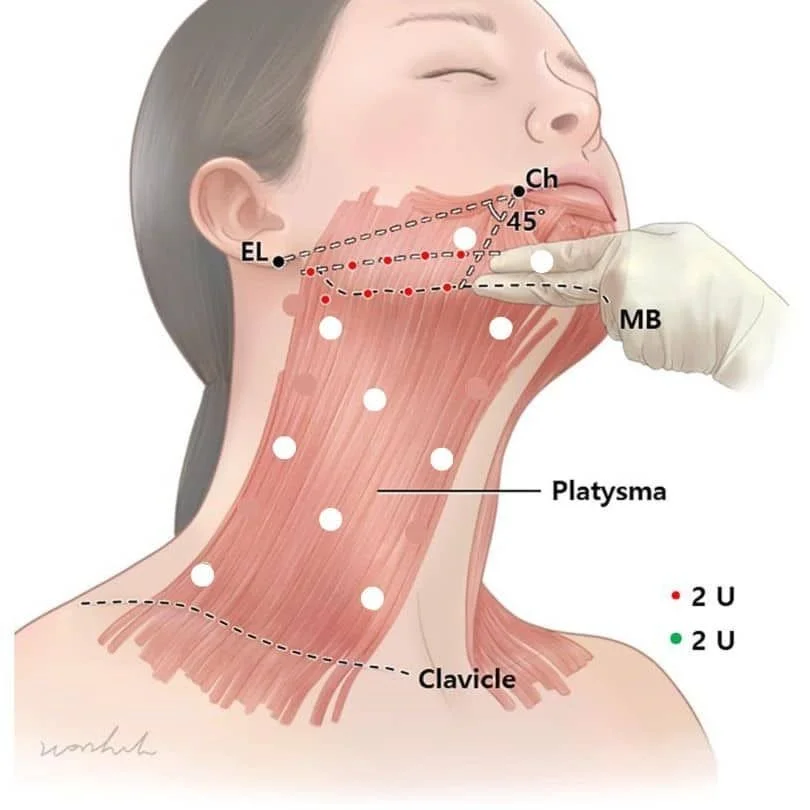
A deep plane surgeon has to know exactly where every branch of the facial nerve runs — and more importantly, exactly how deep it runs — at every point of the dissection. The frontal (temporal) branch, which controls eyebrow elevation, is estimated using surface landmarks such as Pitanguy's line (from a point just below the tragus to about 1.5 cm above the lateral eyebrow) and is dangerous precisely because it has minimal cross-innervation from other branches — an injury here doesn't get quietly compensated for by a neighboring nerve. The marginal mandibular branch, which controls lower lip movement, runs close to the facial vein along the jawline; surgeons who know this anatomy use pressure or hemostatic agents rather than electrocautery near that vessel, because cautery risk to the adjacent nerve is a known, avoidable cause of injury.
Where the "safe plane" actually is — and isn't
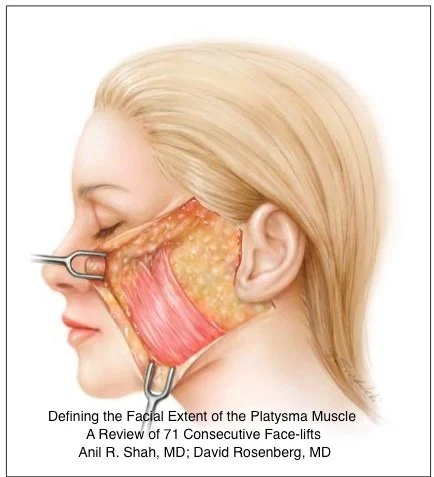
Over the body of the parotid gland, the facial nerve's branches run deep to the SMAS, so a dissection correctly kept in the sub-SMAS plane stays safely superficial to them. But as those branches exit the front edge of the parotid and cross the masseter muscle toward the midface, they become progressively more superficial — turning that region into a genuine anatomical danger zone where the "safe" plane changes as the dissection moves forward. A surgeon who understands this transition intuitively, not just theoretically, is what actually keeps a deep plane dissection safe.
Which ligaments to release, and how far to extend the flap
Releasing the zygomatic and masseteric ligaments is the core of a standard deep plane facelift; extending the release to the mandibular and cervical retaining ligaments (an "extended" deep plane) allows correction of the jawline and neck as part of the same continuous flap. Deciding how far to extend the dissection — and tailoring it to each patient's anatomy, skin quality, and degree of sagging — is a judgment call that only comes from experience with the technique specifically, not facelifts in general.
Flap perfusion and hematoma control
Because deep plane dissection covers more surface area than a skin-only lift, meticulous hemostasis (bleeding control) throughout the procedure matters even more than usual — hematoma is the single most common facelift complication, and a well-controlled bloodless field is also what protects the flap's blood supply and final skin quality.
Vector planning and tension-free closure
A skilled surgeon plans the vertical lift vector individually for each face rather than applying one default pull, and finishes with a closure specifically designed to leave zero tension at the earlobe — the direct, well-documented cause of pixie ear deformity. This final closure step is easy to rush and is one of the more common differentiators between an excellent result and a technically correct but visibly "surgical" one.
How to Tell If a Surgeon Is Actually Good at Deep Plane Facelift
Because deep plane facelift surgery has a steep, well-documented learning curve and only a relatively small proportion of facial plastic and plastic surgeons are formally trained in it, evaluating a surgeon takes more than checking that they offer it on their website. Here is what actually distinguishes a genuinely skilled deep plane surgeon:
Ask about deep plane volume specifically, not total facelift volume
"I've done thousands of facelifts" is not the same claim as "I've done thousands of deep plane facelifts." Ask directly how many deep plane (or extended deep plane) procedures the surgeon performs per year, and how long they've been using this specific technique — not facelifts in general.
Verify fellowship training and board certification
Look for board certification in plastic and reconstructive surgery (e.g. FRACS in Australia, ABPS or ABFPRS board certification in the US) and, ideally, dedicated fellowship training in facial plastic and reconstructive surgery beyond core residency — an additional year or more focused specifically on the anatomy of the face and neck. This is where deep plane technique is typically taught in a structured, mentored way.
Ask to see 12-month-plus results, not just 6-week photos
Early post-operative photos are dominated by swelling and can flatter almost any technique. Because deep plane tissue takes longer to settle than a skin-only lift, the meaningful comparison is results at 12 months or later — ask specifically for these, across a range of ages and face shapes, not a curated highlight reel of the single best outcome.
Look for "refreshed," not "tight" or "different"
A well-executed deep plane facelift restores volume and position without changing identity. If a surgeon's portfolio consistently shows patients who look pulled, hollowed, or noticeably "done," that is a signal about their vector planning and tissue handling — regardless of what the procedure is called.
Ask how they specifically prevent nerve injury and pixie ear
A surgeon fluent in the technique should be able to explain, in plain terms, how they identify the danger zone as the facial nerve crosses the masseter, how they handle bleeding near the marginal mandibular nerve, and how they achieve a tension-free closure at the earlobe. Vague or generic answers to these specific questions are a meaningful red flag.
Ask about their hematoma and revision rates
A confident, experienced deep plane surgeon will discuss their own complication and revision rates candidly and compare them to published benchmarks, rather than deflecting the question.
Confirm which technique they actually perform
"Deep plane," "extended deep plane," and "composite facelift" are related but distinct techniques that release different ligaments and address different areas (midface only, versus midface and jawline/neck, versus midface and lower eyelid). Ask exactly which version the surgeon performs and why they recommend it for your anatomy specifically.
Dr. Rushapol Sdawat, board-certified in plastic surgery by the Medical Council of Thailand since 2000, performs deep plane and extended deep plane facelift surgery at Intrarat Hospital, Bangkok, and discusses technique, the extent of ligament release and expected results in detail at every consultation. See the deep plane facelift page at rushapolsdawat.com/deep-plane-facelift-bangkok.
Frequently Asked Questions
Is a deep plane facelift more painful than a traditional facelift?
Most patients describe post-operative discomfort as pressure and tightness rather than sharp pain, and it is generally manageable with prescribed medication. Pain levels are broadly similar to a traditional SMAS facelift, though swelling may take slightly longer to settle given the more extensive tissue release.
What is the minimum age for a deep plane facelift?
There is no fixed minimum age — candidacy depends on the degree of facial and neck laxity rather than age alone, though most patients undergoing this procedure are in their late 40s through 60s.
Will a deep plane facelift look "overdone" or unnatural?
When performed correctly, a deep plane facelift is specifically associated with a more natural appearance than older techniques, because it repositions tissue along its natural vertical vector instead of pulling the skin sideways under tension.
Can a deep plane facelift be combined with other procedures?
Yes. It is commonly combined with a neck lift, brow lift, blepharoplasty (eyelid surgery), or fat grafting to achieve comprehensive facial rejuvenation in a single surgical session.
How long does the deep plane facelift surgery itself take?
The procedure typically takes 3 to 5 hours under general anesthesia or deep IV sedation, depending on whether additional procedures are performed at the same time.
When can I return to work after a deep plane facelift?
Most patients return to non-strenuous work within 2 to 3 weeks, once the most visible bruising and swelling have subsided; full recovery from residual swelling continues over several months.
What's the difference between a deep plane facelift and an extended deep plane facelift?
A standard deep plane facelift releases the zygomatic and masseteric retaining ligaments to correct the midface and cheek. An extended deep plane facelift also releases the mandibular cutaneous and cervical retaining ligaments, allowing the jawline and neck to be repositioned as part of the same continuous flap rather than as a separate procedure.
What is a composite facelift, and is it the same as a deep plane facelift?
A composite facelift is Dr. Sam Hamra's later evolution of the deep plane technique: it adds release of the orbicularis oculi muscle around the eye, so the lower eyelid, cheek, and midface move together as one unit. It is closely related to a deep plane facelift but addresses the lower eyelid-cheek junction more directly.
What is the actual risk of facial nerve injury during a deep plane facelift?
Published data suggests temporary injury to the temporal (frontal) branch — which controls eyebrow movement — occurs in up to roughly 2.6% of cases, almost always resolving as swelling subsides. The marginal mandibular branch, affecting lower lip movement, is affected in around 0.5% of cases temporarily, with permanent injury occurring in roughly 0.1% of cases. Risk is meaningfully lower with a surgeon who has high, specific deep plane case volume.
Why does deep plane technique reduce the risk of a pixie ear deformity?
Pixie ear deformity is caused by excess tension pulling the earlobe downward during skin closure, typically from over-reliance on skin tension to hold a lift in place. Because deep plane technique repositions the deeper SMAS and ligamentous structures to hold the lift, the skin can be closed with minimal tension at the lobule — lowering, though not eliminating, this specific risk.
How can I tell from before-and-after photos if a surgeon is skilled at deep plane facelift?
Look for photos taken at 12 months or later rather than a few weeks post-op, natural cheek volume and jawline definition rather than a flattened or "windswept" look, symmetric results across many different patients and face shapes, and inconspicuous scarring along the hairline and ear. Consistency across a large portfolio matters more than any single dramatic result.
Book a Deep Plane Facelift Consultation
Discuss your candidacy, techniq

