Most visible bruising and swelling settle over two to three weeks, you should plan to stay in Bangkok for at least two weeks after surgery, and the last subtle swelling and numbness can take up to a year to fade. This guide walks you through each stage, in Bangkok and after you fly home, with the practical details overseas patients need. It is general information: the instructions your own surgeon gives you always come first.
Why deep plane recovery has its own timeline
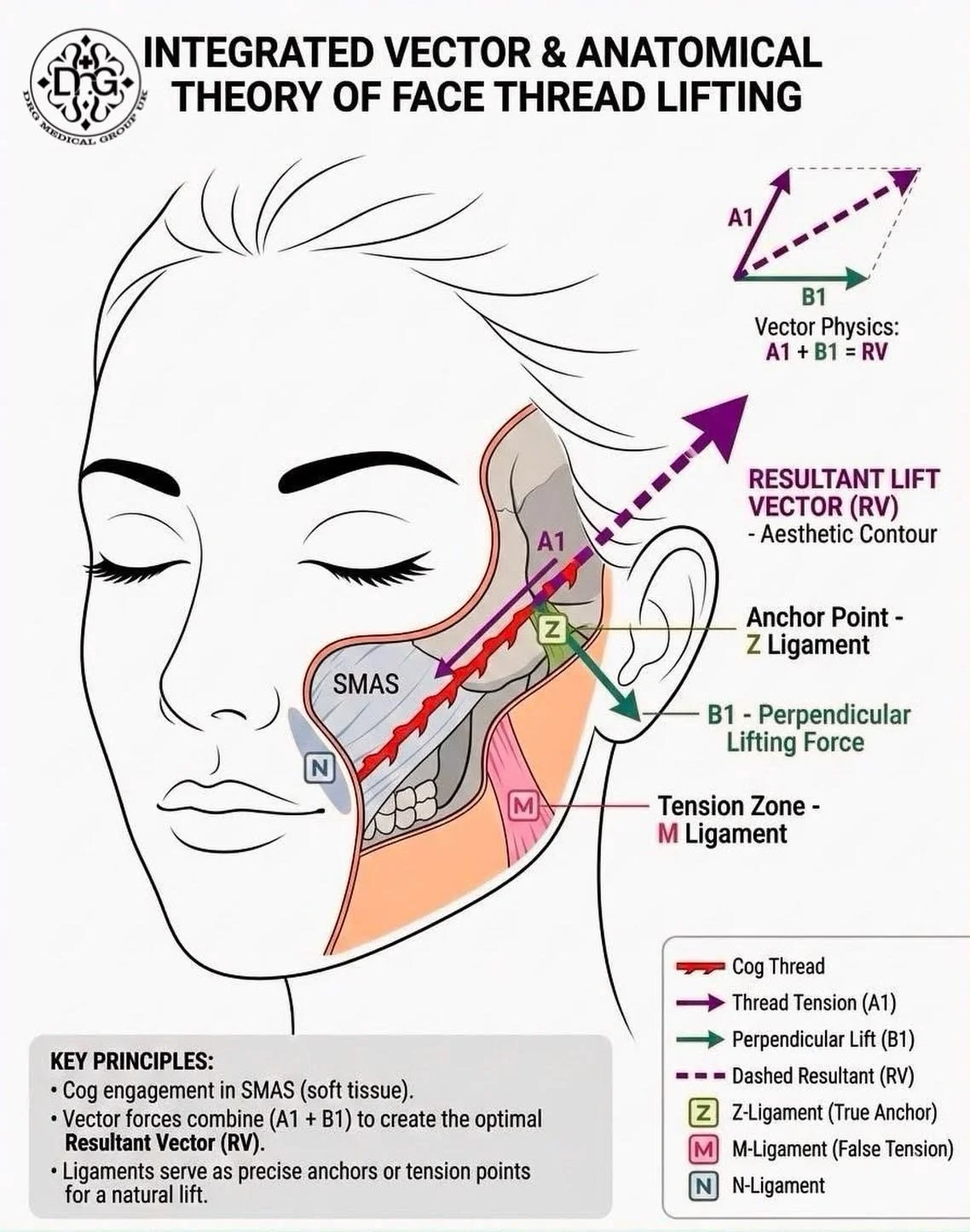
A deep plane facelift lifts the face's deeper support layer, not just the skin, and that is what shapes your recovery. Under the skin sits the SMAS (superficial musculoaponeurotic system), a sheet of tissue that holds the cheeks, jowls and neck in position. The surgeon works beneath this layer and releases the ligaments that tether it, so skin and SMAS are lifted together as one unit.
Three things follow from that:
Swelling sits deeper and lasts longer. Your face can feel full, firm and tight for weeks, even after the bruising has gone.
Numbness is expected. Small sensory nerves are stretched during surgery. Feeling usually comes back gradually over weeks to months, and the skin around the ears is often last.
The skin stays attached to the layer beneath it. This is thought to protect its blood supply. A 2026 review of 10,784 deep plane patients found skin necrosis (loss of skin) in 0.1%.
A deep plane facelift can be combined with a neck lift, brow lift or eyelid surgery. Each added procedure lengthens the operation and adds to your swelling and recovery time.
Recovering overseas adds one more layer. You spend the first fortnight away from home, then finish healing after a long-haul flight. The rest of this guide plans for both.
Before you fly: six weeks of preparation at home
What you do in the six weeks before surgery affects your safety as much as anything that happens in theatre.
Six weeks before
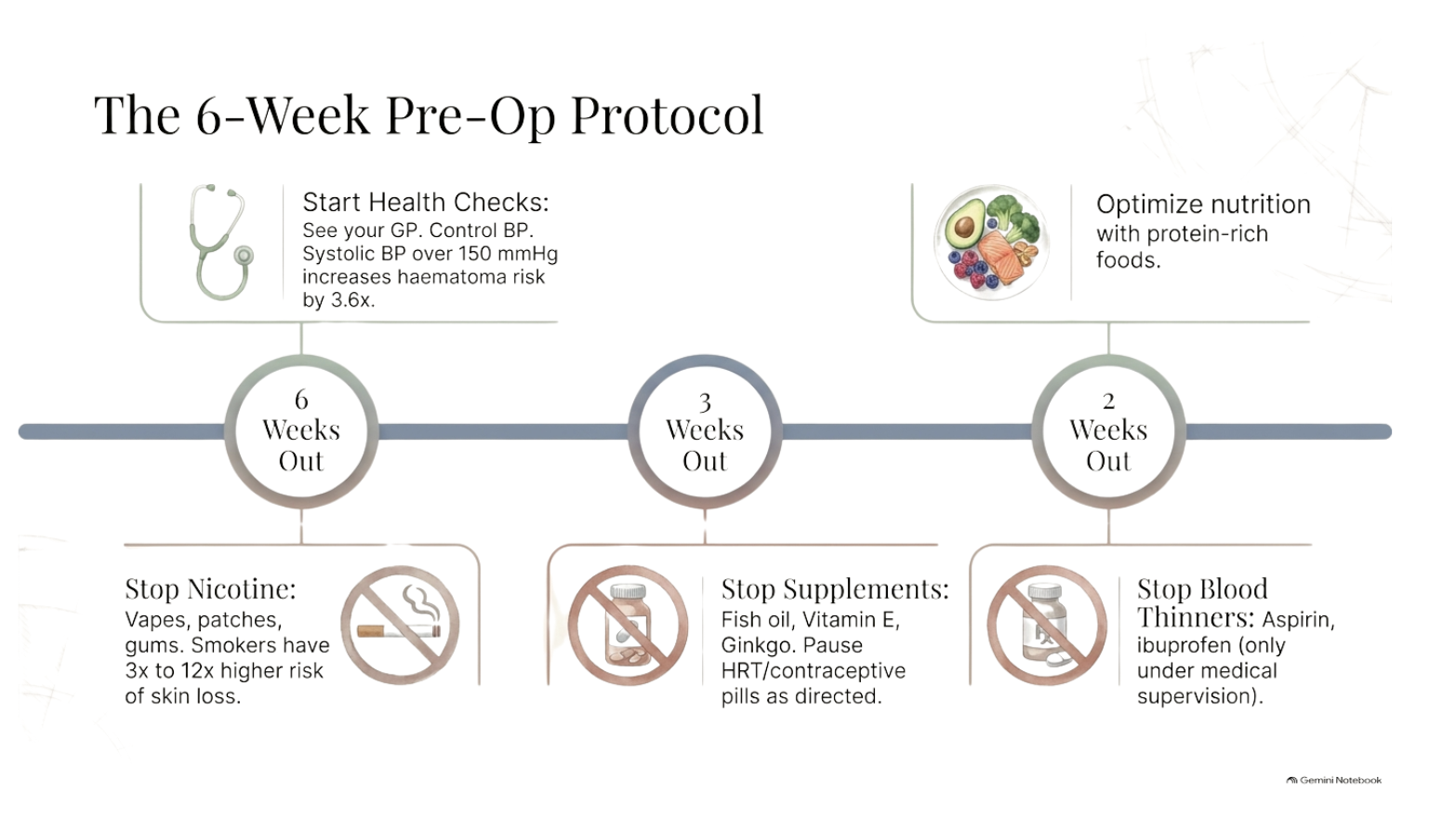
Stop all nicotine. That means cigarettes, vapes, patches, gum and pouches. Nicotine narrows the small vessels that feed the lifted skin. Many surgeons ask for four to six weeks nicotine-free before surgery and several weeks after, and studies put skin-loss risk in smokers at roughly 3 to 12 times higher.
See your GP. Get your blood pressure checked. High blood pressure is one of the biggest risk factors for haematoma, a collection of blood under the skin. Ask for a short letter listing your conditions, medications and recent test results.
Ask about HRT and the contraceptive pill. Both raise the risk of blood clots after surgery. Your surgeon may ask you to pause HRT about three weeks beforehand, so plan this with your surgeon and GP together.
Tell us everything. Previous facial surgery, fillers, threads, anti-wrinkle injections and any past problems with anaesthetic or healing all change the surgical plan.
Sort insurance. Standard travel insurance rarely covers planned surgery. See the insurance section below.
Book your time off. Allow at least two weeks in Bangkok after surgery, with a flexible return ticket, then more time at home before work.
Two to three weeks before
Stop blood-thinning medicines and supplements on the schedule your team gives you. This usually includes aspirin, ibuprofen and other anti-inflammatories, fish oil, vitamin E, ginkgo and ginseng.
Never stop a prescribed blood thinner on your own. That includes aspirin taken for your heart. Your prescribing doctor and your surgeon need to agree a plan, and sometimes the safe answer is to postpone.
Keep taking blood pressure medication unless you are told otherwise. Blood pressure spikes after surgery are a known cause of bleeding.
What to pack for recovery
Button-front or zip-front tops, so nothing pulls over your face
A travel neck pillow for sleeping with your head raised
Properly fitted below-knee compression stockings for the flight home
A wide-brimmed hat, sunglasses and SPF 50+ sunscreen for healed skin
A scarf or high collar for the journey home
Lip balm, as swelling can dry and stretch the lips
Your GP letter, medication list and insurance documents, on paper and on your phone
Week 1 in Bangkok: surgery to day 7
The first week is for rest and close monitoring, not sightseeing.
Surgery day and the first night
A deep plane facelift is done under general anaesthetic and usually takes three to six hours. Combined procedures take longer.
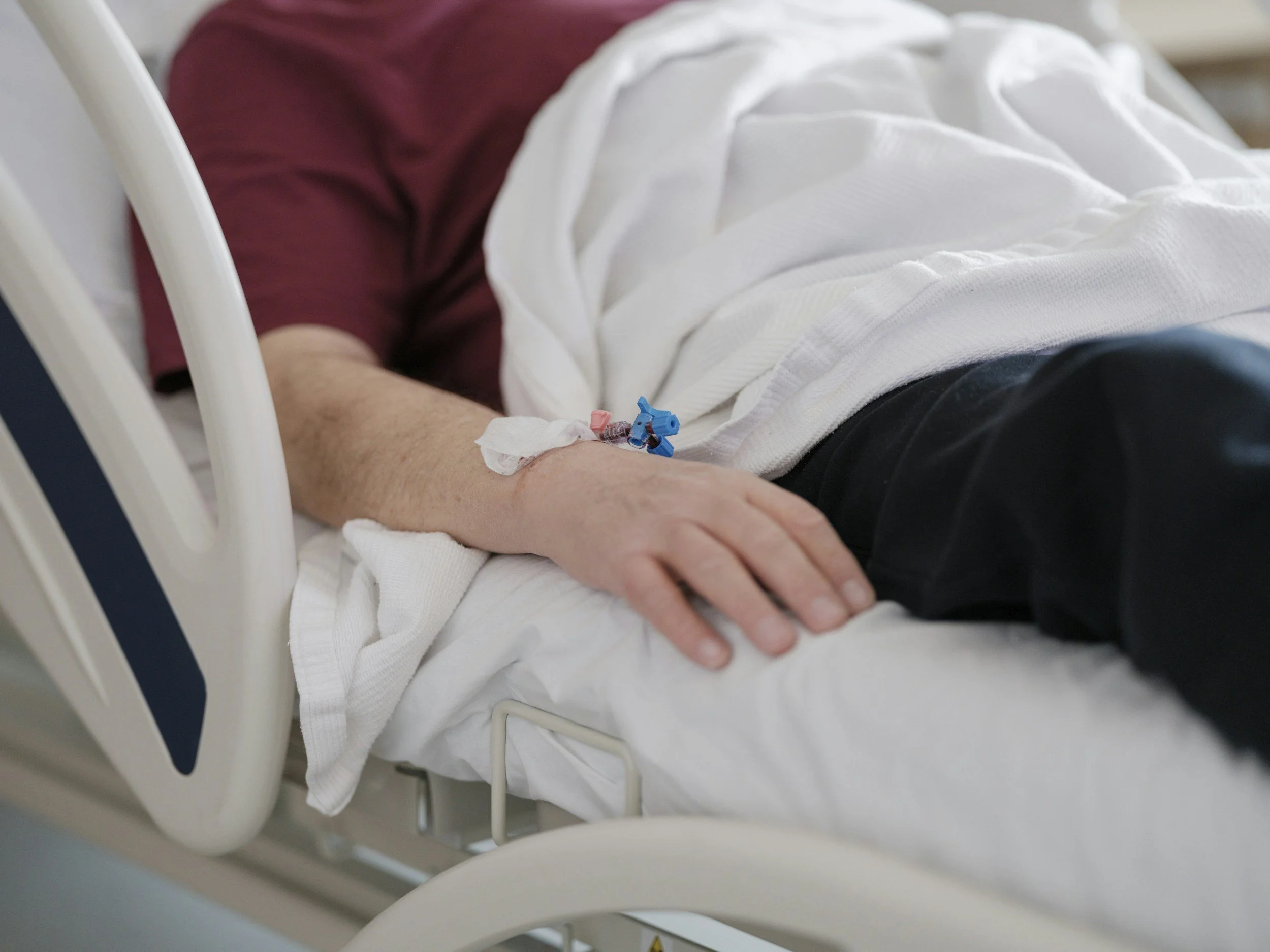
You wake with a padded pressure dressing around your face and neck, and often a small drain tube behind one or both ears.
The first 24 hours are watched most closely. About 90% of haematomas appear within the first 24 hours, so nurses keep your blood pressure, pain and nausea tightly controlled.
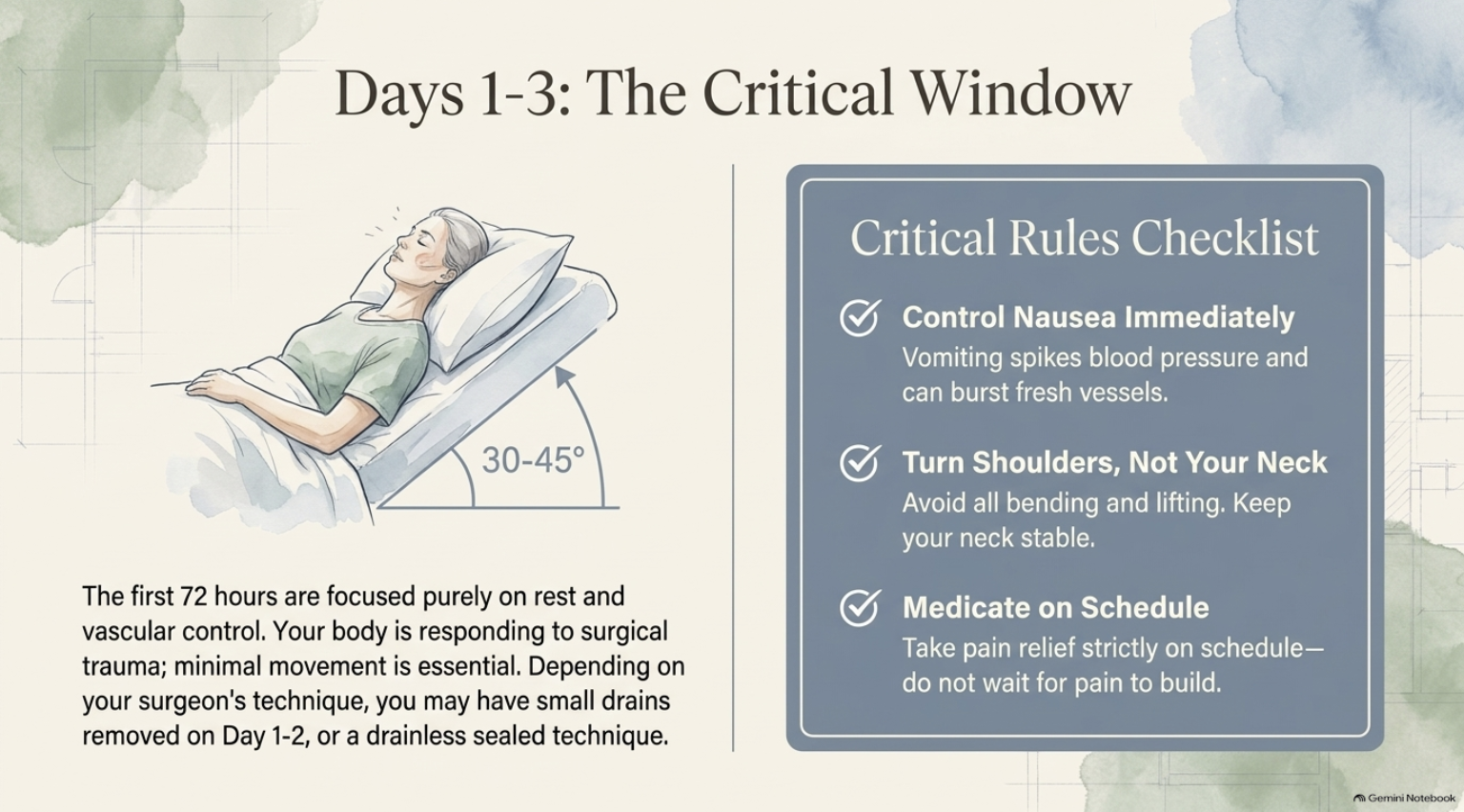
Nausea matters more than it seems. Vomiting and straining push up blood pressure in freshly sealed vessels, so tell the nurses early if you feel sick.
Days 1 to 3
Drains and dressings. Drains usually come out on day 1 or 2. The bulky dressing is swapped for a lighter elastic garment within the first few days.
Peak swelling. Swelling and bruising build and usually peak around days 2 to 4. This is expected, not a sign that something is wrong.
Head up. Rest and sleep on your back with your head raised on two or three pillows, or semi-reclined.
Cool packs. Use them as your team instructs, wrapped in cloth and never directly on skin. Numb skin cannot warn you when it is getting too cold.
Move your legs. Walk gently around your room several times a day to keep blood flowing.
Protect the lift. Avoid bending forward, lifting, and sharp head turns. Turn your shoulders with your head.
Pain relief. Day one is usually when you need it most. Take it on schedule rather than waiting for pain to build.
Food. Soft, easy-to-chew meals; chewing and opening wide can feel tight.
Days 4 to 7
Most people no longer need prescription pain relief by days 4 to 6, and swelling begins to ease.
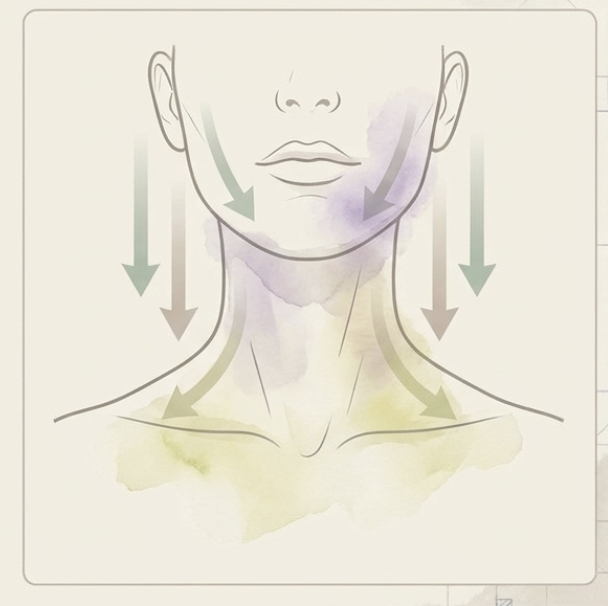
Bruising changes colour and often drifts down towards the neck and collarbones as it clears. This is normal.
Once your surgeon is happy, you move from hospital to your recovery accommodation and return for scheduled check-ups.
The first stitches usually come out around day 7. Some, often behind the ears and in the hairline, stay into week 2.
Wash your hair only when your team says you can, and gently.
Light activity around your accommodation is fine. Keep resting: healing is still in its early stage.
Week 2 in Bangkok: stitches, check-ups and fit-to-fly
By the end of week 2, many people feel like themselves again, even though swelling, tightness and numbness are still obvious to them.
Stitches. Remaining stitches or staples come out. Tingling, tightness and patches of numbness around the ears, cheeks and jawline are common now.
Walking. Short, regular walks help circulation and swelling. Choose air-conditioned spaces, such as hotel corridors or a quiet shopping centre in the morning, over hot streets.
Your final review. Your surgeon should see you in person before you fly and confirm you are fit to travel. UK cosmetic tourism guidance (BAAPS) recommends the same surgeon reviews you, at least once, before you go home.
Paperwork to take home. Ask for a written summary of what was done, your medications, wound-care instructions and how to contact the team. Your GP will need it.
Bangkok-specific precautions for the first fortnight
Heat and sun. Bangkok is hot and humid all year. Heat and exertion can make swelling worse, and sweat irritates fresh incisions. Stay in air-conditioning in the middle of the day and keep scars out of direct sun.
Food and water. Stick to freshly cooked food and sealed bottled water. A stomach bug now is more than an inconvenience: vomiting raises blood pressure, which is linked to bleeding after a facelift.
No massage, spa, sauna or steam. Wait for your surgeon's clearance before any massage of the head, face or neck. Traditional Thai massage often includes neck stretches, so leave it until later.
No swimming. Keep out of hotel pools until your incisions have fully healed and you are cleared.
Alcohol. Skip it while you are taking prescribed medication, and ask your surgeon when it is fine to resume.
Support. A companion for at least the first few days makes recovery much easier. Your coordinator is your first point of contact for anything you need during your stay.
The flight home: reducing clot risk on a long-haul flight
Fly only once your surgeon has confirmed you are fit to fly, which for a deep plane facelift means at least two weeks after surgery, and sometimes longer. Every direct flight from Bangkok to Australia or New Zealand takes well over four hours; Melbourne and Sydney are around nine hours away.
Sitting still for hours soon after surgery raises the risk of deep vein thrombosis (DVT), a clot in the leg, and pulmonary embolism, a clot that travels to the lungs. Guidance on how long to wait varies:
Guidance
How long to stay near your surgeon after surgery
ISAPS (International Society of Aesthetic Plastic Surgery)
At least one week, depending on the procedure
BAAPS (British Association of Aesthetic Plastic Surgeons), for trips of about 4 hours or more and operations over 3 hours under general anaesthetic
Arrive 1 week before surgery; stay 2 to 4 weeks after
A deep plane facelift usually takes three to six hours, which puts it in the BAAPS 2-to-4-week group. Some UK clinics go further and advise waiting six weeks before a long-haul flight after a facelift. Ask your surgeon which applies to you, and keep your return date flexible.
On the day
Wear properly fitted compression stockings.
Book an aisle seat. Get up and walk regularly, and flex your calves and ankles while seated.
Drink plenty of water. Skip alcohol and sleeping tablets that keep you still for hours.
Don't lift heavy bags into the overhead locker. Check them in or ask for help.
Expect some extra puffiness. Cabin pressure changes can temporarily increase facial swelling.
Keep your surgical summary, medication list and your team's contact details in your hand luggage.
Are you at higher clot risk?
BAAPS asks surgeons to pay particular attention to patients who are over 40, have a BMI over 30, have had a clot before, have a family history of clots, or take oral HRT or the contraceptive pill. If any apply, ask your surgeon whether you need extra protection, such as blood-thinning injections, around surgery and the flight.
Weeks 3 to 4 at home: back to work and the in-between stage
Most people are socially presentable by weeks 2 to 3, but the face is still settling, and that is the part that tests patience.
Work. Many people return to desk work at around two to three weeks, which for travelling patients means a few days after landing. Physically demanding work, including ward nursing with its bending, lifting and long shifts, commonly needs four to six weeks at minimum. Plan your return with your surgeon before surgery.
Makeup. Light makeup can cover leftover bruising once the skin is intact. Keep it off incisions until they have fully healed and your surgeon agrees.
The in-between stage. Swelling often settles unevenly, so one side may look fuller than the other, and some areas can feel firm or lumpy. This is common, and it is too early to judge your result.
Mood. Feeling flat or impatient at this stage is common. You look different from before surgery, but not yet like the settled result. Comparing daily photos taken in the same light helps more than checking the mirror.
Exercise. Keep walking daily. Light exercise can usually restart around weeks 3 to 4 if your surgeon agrees. If swelling increases afterwards, ease back.
Driving. Wait until your surgeon clears you, you are off strong pain relief, and you can turn your head fully to check blind spots.
Follow-up from home. BAAPS recommends phone or video follow-up once you are home. Send photos at the agreed points, and see your GP for a wound check if anything worries you.
Week 5 to month 12: the long, quiet finish
After the first month the changes are small and slow, and most of them are noticeable only to you.
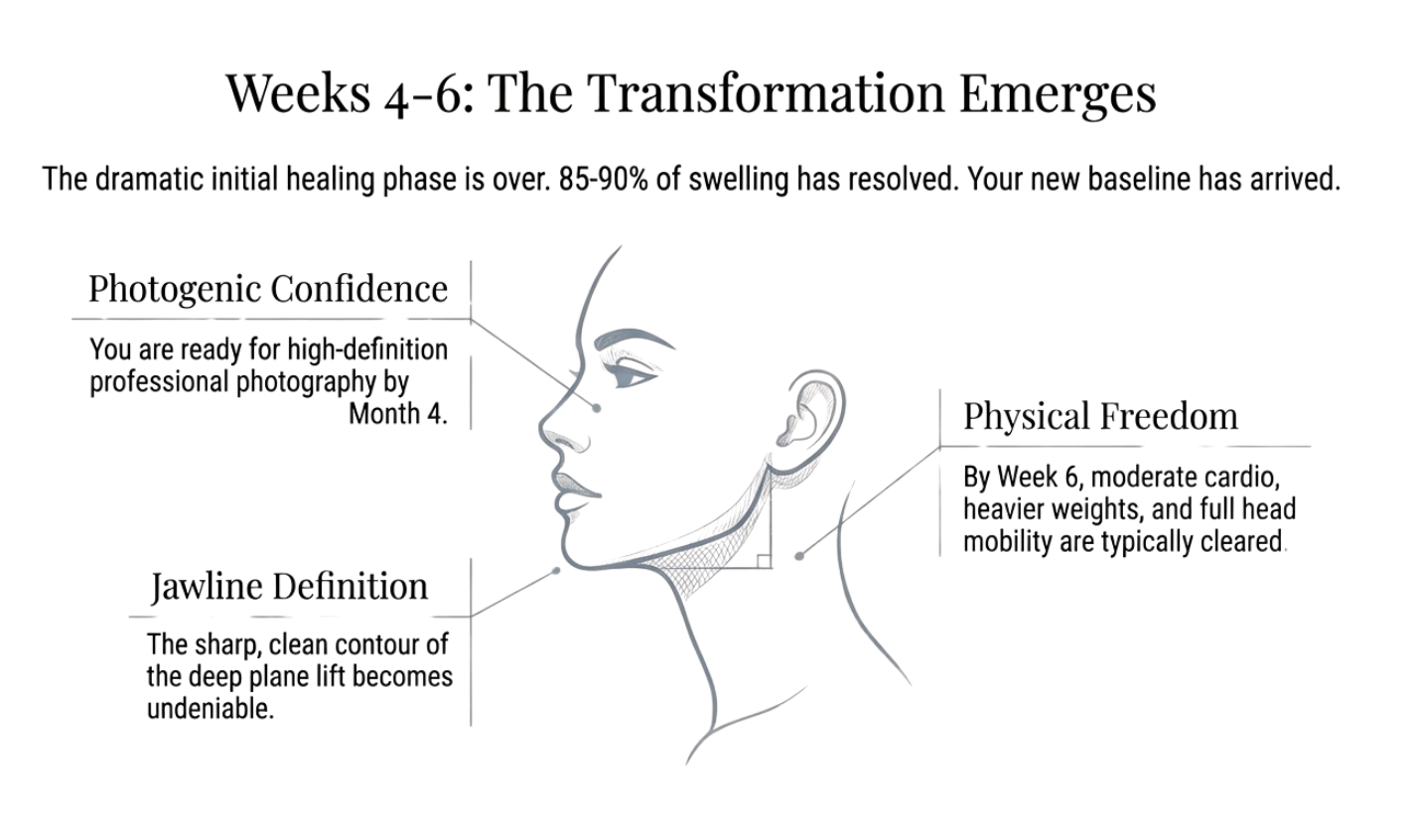
Exercise. Strenuous workouts, heavier weights and contact sports usually wait six to eight weeks after a deep plane facelift, and only with your surgeon's clearance.
Swelling. Contour changes are often visible from weeks 3 to 4. Very minor swelling, tightness and numbness can take up to a year to resolve fully.
Feeling. The cheek usually recovers first, then the jawline and neck. Skin just in front of the ear and the earlobe are often slowest. A small patch of altered feeling can persist, most often at the earlobe.
Scars. Incisions run around the ear and into the hairline. They start pink and fade over many months. They do not disappear, but the hairline and the shape of the ear usually hide them. About 3 in 100 patients develop a thicker, raised scar; treatments such as steroid injections can help.
Hair. Hair near the incisions can thin, usually temporarily. If it is lasting, it can be treated.
Sun. Protect scars from direct sun with a hat and, once healed, SPF 50+.
Check-ups. BAAPS recommends further assessment between six weeks and six months after surgery, in addition to the early reviews.
Your face keeps ageing. A facelift resets the starting point; it does not stop time. Sun protection, not smoking and a stable weight help, because repeated weight changes alter the shape of the face and the condition of the skin.
Risks in real numbers
In a 2026 review pooling 45 studies and 10,784 deep plane facelift patients, 6.6% had a complication of some kind, and no permanent facial nerve injury was reported, though permanent nerve injury is rare rather than impossible. These are averages from published series, often by experienced surgeons. They describe the procedure, not a promise for any one person.
Complication
Raised (hypertrophic) scarring
2.8%
A thicker scar, often treatable
Haematoma
1.8%
Blood collecting under the skin; may need draining
Seroma
1.7%
Clear fluid collecting under the skin; usually drained
Temporary facial nerve weakness
1.2%
Weaker movement in part of the face that recovers
Epidermolysis
1.2%
Superficial peeling or blistering of the skin
Infection
0.8%
Usually treated with antibiotics
Skin necrosis
0.1%
Loss of an area of skin
Permanent facial nerve injury
None reported
In the pooled studies; rare, but possible
A separate 2025 review of 8,841 deep plane patients found a 2.7% overall haematoma rate, and 0.97% for major haematomas.
What raises your risk
A 2001 study of facelift haematoma identified these as the main risk factors before surgery:
Risk factor Relative risk of haematoma
Systolic blood pressure above 150 mmHg 3.6 times
Male sex 2.8 times
Aspirin or anti-inflammatory use 2.0 times
Smoking 2.0 times
Most of these you can influence: get your blood pressure controlled, stop nicotine, follow the medication schedule, tell the nurses early about nausea, stay for the full observation period, and follow the flight precautions. Longer, combined operations also carry more surgical and anaesthetic risk, which is worth weighing when you choose how much to do in one session.
Insurance and cover for Australian and New Zealand patients
Sort out cover before you book, because standard policies rarely protect you for planned surgery.
Australia
Medicare does not cover you overseas. You are responsible for the cost of treatment abroad, including any further care or medical evacuation.
Basic travel insurance rarely covers medical tourism, and most policies exclude elective or cosmetic procedures and their complications. Specialised policies exist; Smartraveller advises getting one that covers your specific procedure.
Private health insurance may not cover treatment overseas. Check your policy.
New Zealand
ACC does not pay for treatment overseas.
A complication from overseas surgery may be covered as a treatment injury once you are back, but only if it meets ACC's criteria, the treatment met New Zealand-equivalent standards, and you are ordinarily resident in New Zealand.
Ask for a full written medical report before you leave; ACC claims rely on it.
For everyone
Declare the surgery when you buy any policy. Claims have been refused where travellers did not disclose planned surgery.
Before you book, ask in writing what happens, and who pays, if you need extra nights, extra treatment or a return to theatre.
Frequently asked questions
How long should I stay in Bangkok? Plan on at least two weeks after a deep plane facelift, and longer if you combine procedures; BAAPS suggests two to four weeks for operations over three hours. It also suggests arriving about a week before surgery, which leaves time for your in-person consultation, pre-operative tests and recovering from the flight. Book a flexible return ticket. Your surgeon decides when you are fit to fly.
Can I combine it with a neck lift or eyelid surgery? It is possible, but it is a medical decision, not a package choice. Combining procedures means a longer operation and anaesthetic, more swelling, a longer stay and more risk; neck tightening in particular has been linked to a higher haematoma rate. Your surgeon will advise whether combining makes sense for you.
Will it hurt? The first day is usually when pain relief is needed most. Most people no longer need prescription pain medication by days 4 to 6. Tightness and numbness tend to last longer than pain.
When will I see the result? Contour changes are often visible from weeks 3 to 4. The face keeps refining for months, and the last subtle swelling can take up to a year.
Is the numbness permanent? Usually not. Feeling returns gradually over weeks to months, and the earlobe is often last. A small patch of altered sensation can persist in some people.
Will a facelift fix fine lines and sun damage? No. A facelift does not treat fine lines, sun damage, creases around the nose and upper lip, or uneven skin colour. Skin treatments can be planned separately, once you are cleared.
Who looks after me once I am home? Follow-up continues with your surgeon's team by video call and photos. Your GP can check wounds and remove any leftover stitches if asked to. Bring your surgical summary so any doctor at home knows exactly what was done.
Can I go sightseeing while I recover? Not in the first fortnight. Rest, short walks in air-conditioned places and your check-ups come first. Recovery is not a holiday, and doing too much too early can set healing back.
Next step: start with an assessment
Every recovery plan starts with your face, your health and your travel dates. Send us your photos and health history through our consultation form, and we will arrange a review with Dr. Rushapol Sdawat, a plastic surgeon registered with the Medical Council of Thailand (licence no. 17689). If surgery suits you, we coordinate the practical side around it, including surgery dates, check-ups, where you will recover and the fit-to-fly timing, so you know the whole picture before you book a flight.
Questions first? Message us on WhatsApp at +66 82 262 5556 or visit medsanctuary.com.
This guide is general information, not medical advice, and recovery differs between people and procedures. Follow the instructions your surgeon gives you. Any surgical or invasive procedure carries risks. Before proceeding, you should seek a second opinion from an appropriately qualified health practitioner.
Sources
Recovery timeline and risks
American Society of Plastic Surgeons: Your facelift recovery explained from Day 1 to Day 30
Mayo Clinic: Face-lift
Aesthetic Plastic Surgery (2026): Deep plane facelift complications, systematic review and meta-analysis (abstract)
Facial Plastic Surgery & Aesthetic Medicine (2025), summarised by ReachMD: Hematoma rates in deep plane facelifts
Archives of Facial Plastic Surgery (2008): Hematoma rates in drainless deep-plane face-lift surgery
Dr Scott Turner, FRACS: Recovery after facelift and Numbness after facelift surgery
Dr Jeremy Hunt: Facelift numbness: how long it lasts
Centre for Surgery: Smokers and cosmetic surgery and Does vaping affect cosmetic surgery results?
Travel and flying
Australasian Society of Aesthetic Plastic Surgeons: The lure of cosmetic tourism
Centre for Surgery: How soon can I travel after cosmetic surgery?
Facial Artistry: Flying after a facelift
Airport Overview: Melbourne to Bangkok route details
Insurance and cover
Smartraveller: Going overseas for a medical procedure and Sun, sand and surgery
Better Health Channel (Victoria): Medical tourism
SafeTravel NZ: You're sick or injured
Insurance Business NZ: Kiwis face risks with overseas surgery and limited insurance
Emergency numbers
Thailand Starter Kit: Emergencies in Thailand

