
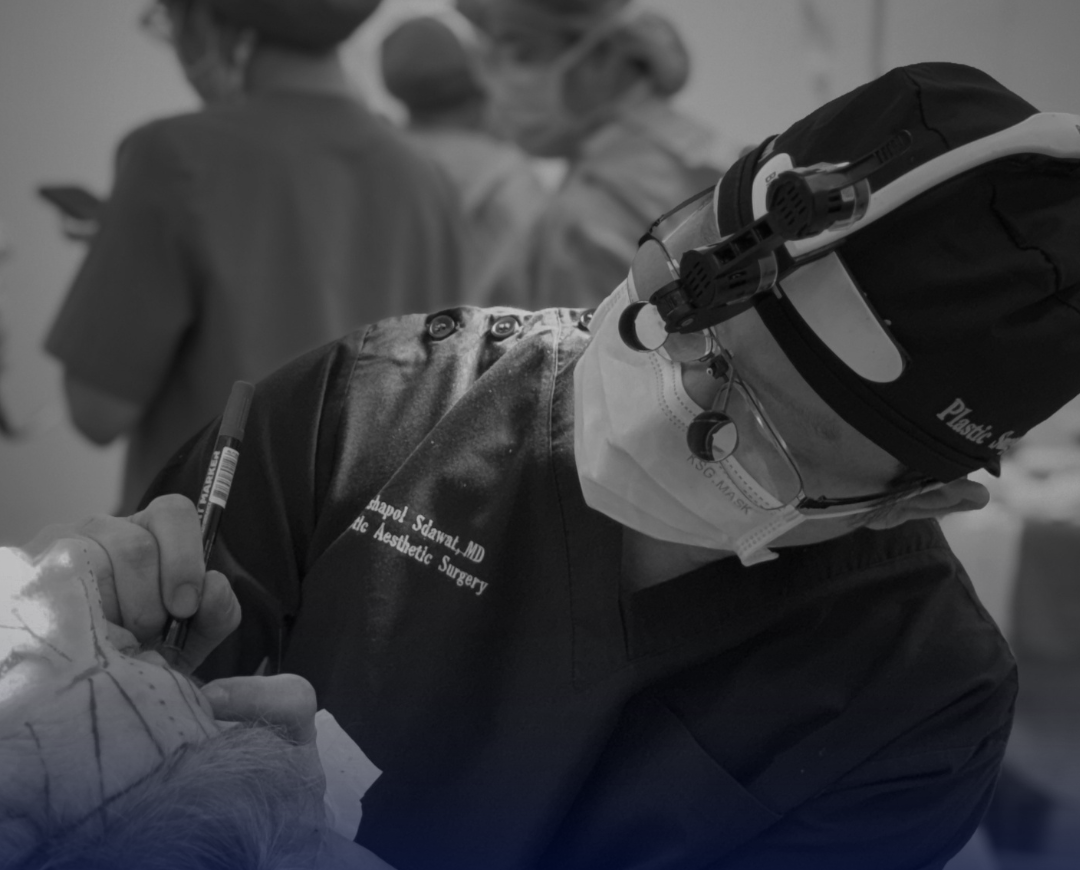
Breast Lift (Mastopexy) in Bangkok
Performed by Dr. Rushapol Sdawat, M.D. — board-certified in plastic surgery by the Medical Council of Thailand since 2000 — at Intrarat Hospital, a full hospital with its own anaesthesia department and intensive care unit.
Raising and reshaping the breast — not only removing skin
A breast lift (mastopexy) raises the nipple and areola, removes stretched skin and reshapes the breast tissue so that it sits higher on the chest. It treats droop — called ptosis — that follows pregnancy, breastfeeding, weight change and age, as the skin and the breast's internal support stretch.
A lift changes position and shape, not size. Where the upper breast has also emptied, volume can be restored with an implant, either at the same operation or as a second stage. The areola can be reduced in size at the same time.
Your operation is performed by the surgeon you consult
Dr. Sdawat plans a lift from measurements taken at examination — nipple position, the distance from the nipple to the breast fold, skin quality and breast volume — and explains which pattern he recommends, why, and where the scars will sit.
- ✓Board-certified in plastic surgery since 2000Diploma of the Medical Council of Thailand certifying proficiency in Plastic Surgery, issued 13 July 2000 · licence No. 17689
- ✓The Society of Plastic and Reconstructive Surgeons of ThailandQualified June 2000 · full member since August 2001
- ✓ISAPS member since 2008International Society of Aesthetic Plastic Surgery
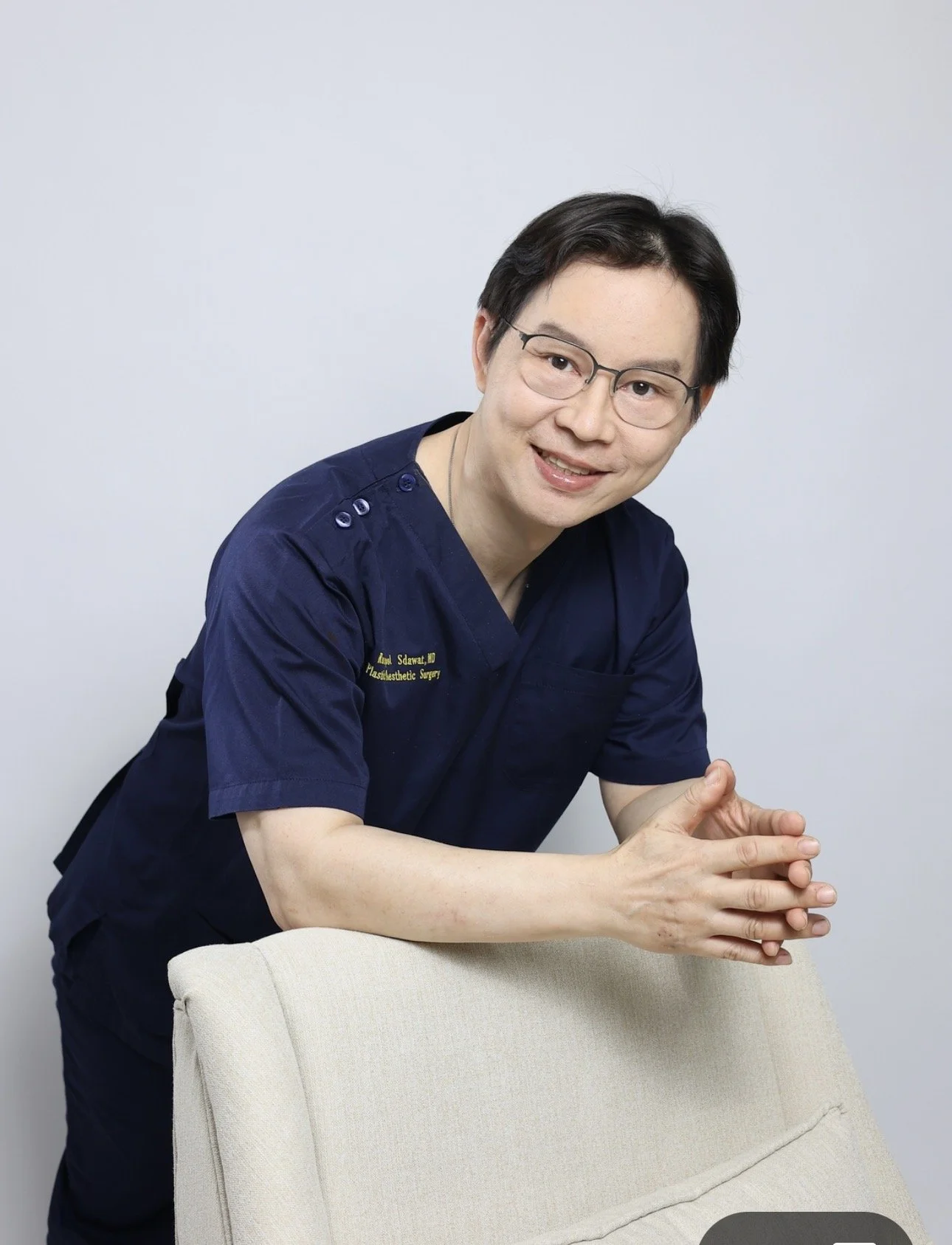 Dr. Rushapol Sdawat, M.D.
Which lift pattern — and when an implant is added
The pattern is chosen by how far the nipple has descended relative to the breast fold and how much loose skin there is. These are the usual matches; the final choice is made at examination.
| Pattern | Usually suited to | Scar | Trade-off |
|---|---|---|---|
| Periareolar | Mild droop, where the nipple needs to rise only a short distance | Around the edge of the areola | Limited lift; pushed too far it can widen the areola or flatten the breast |
| Vertical (“lollipop”) | Moderate droop | Around the areola and straight down to the fold | No scar in the breast fold; the shape takes a few months to settle |
| Inverted-T (“anchor”) | Marked droop or a large amount of loose skin | Around the areola, down to the fold and along the fold | Removes the most skin and gives the most control of shape, with the longest scar |
| Lift with implant | Droop together with loss of upper-breast volume | As for the lift pattern chosen | Two goals in one operation; a higher revision rate than either operation alone |
One operation or two?
Combining a lift with an implant (augmentation-mastopexy) asks one operation to do two things that pull in opposite directions: the implant stretches the skin envelope while the lift tightens it. Published series report higher complication and reoperation rates for the combined operation than for either operation alone — one review of nearly 5,000 single-stage operations reported reoperation in about one in ten patients.
For many women a single operation is appropriate. For others — particularly where there is a large amount of loose skin or a large implant is wanted — doing the lift first and adding an implant a few months later gives more control. Your written plan states which approach is recommended and why.
Implant choices, the implant-specific risks and the follow-up that implants need are set out on the breast augmentation page.
Who this operation is for — and who it is not for
Suitability can only be determined by consultation and in-person assessment. These are the patterns Dr. Sdawat looks for.
A good candidate usually has
- Breasts that have descended after pregnancy, breastfeeding or weight loss
- Nipples at or below the breast fold, or pointing downward
- A stable weight, with no plan to lose a large amount
- Finished having children — or an understanding that pregnancy can undo the lift
- No nicotine — or the ability to stop every nicotine product for the period the surgeon requires
- Breast screening up to date for your age, with any lump or abnormal result already investigated
- Realistic expectations, including permanent scars
Dr. Sdawat will not operate when
- You are pregnant or breastfeeding, or stopped only recently
- A breast lump or abnormal mammogram or ultrasound has not been investigated
- Nicotine cannot be stopped — cigarettes, vaping, patches or gum reduce blood supply to the skin and nipple and raise the risk of wound breakdown
- Blood pressure or diabetes is uncontrolled, or there is a bleeding disorder or anticoagulant that cannot be safely paused
- Heart, lung or kidney disease makes a general anaesthetic unsafe
- The main goal is a much smaller breast — a breast reduction is the right operation
How it is performed
The skin pattern is marked with you standing on the morning of surgery. Under general anaesthesia, the nipple and areola are moved upward on a pedicle — a bridge of breast tissue that keeps their blood and nerve supply attached — and the breast tissue beneath is reshaped and supported with internal sutures. Loose skin is removed and the incisions are closed in layers.
If an implant is part of the plan, it is placed through the same incisions before the lift is completed. A small drain is sometimes used and is removed before you leave Bangkok.
Anaesthesia
General anaesthesia given by a hospital anaesthetist from Intrarat Hospital's anaesthesia department, with continuous monitoring throughout.
Operating time
Typically two to three hours for a lift, and longer when an implant is added or other procedures are combined.
Hospital stay
Usually one night in hospital for observation, pain control and the first check of the dressings and bra.
Surgery in a full hospital, not a clinic
Intrarat Hospital, Bangkok: operating theatres, its own anaesthesia department and an intensive care unit, certified ISO 9001:2015.
A hospital anaesthetist gives the general anaesthetic and stays with you throughout the operation. Overnight nursing, and — if it is ever needed — a return to theatre or intensive care, are available in the same building.

What actually happens, week by week
Recovery varies between individuals; this is a general guide only.
Day 0–1 · Hospital
Overnight in hospital. A surgical bra is fitted; a small drain is sometimes used. You walk the same day or the next morning.
First week
Tightness, swelling and bruising are expected. Sleep on your back with your upper body raised. Short walks several times a day; no lifting.
Week 2 · Review
Wound check and surgeon review. Clearance to fly is given after review, usually at around two weeks.
Weeks 3–6
Supportive bra day and night for around four to six weeks. Desk work usually after one to two weeks; no heavy lifting for six weeks.
Months 3–12
Swelling settles and the shape softens. Scars mature and fade over 12 to 18 months.
Where the scars sit and how they heal
Where
Every lift leaves a scar around the areola. A vertical lift adds a line from the areola down to the breast fold; an anchor lift adds a scar along the fold. All sit on the lower half of the breast, where a bra or swimwear usually covers them.
How they heal
Scars are pink and firm for the first months, then gradually flatten and fade over 12 to 18 months. They are permanent. Some people form thickened or widened scars; people with darker skin and those who have had keloid scars before are at higher risk. Silicone gel or sheets once the wounds have healed, and protecting scars from the sun, are the measures with the best evidence.
All surgery carries risk. These are the recognised ones.
- Bleeding or haematoma (blood collecting under the skin), which may need a return to theatre
- Infection
- Delayed wound healing, most often where incisions meet
- Change in nipple or breast sensation — reduced, increased or, occasionally, permanent loss
- Partial or, rarely, complete loss of the nipple and areola if their blood supply is impaired
- Fat necrosis — firm lumps where fatty tissue has lost its blood supply
- Asymmetry of size, shape or nipple position
- Thickened, widened or raised scars
- The breast descending again over time
- Reduced ability to breastfeed
- With an implant: capsular contracture, rupture, implant malposition and the other implant-related risks
- Blood clots in the legs or lungs (DVT or pulmonary embolism)
- Risks of general anaesthesia
- The need for revision surgery
How long does a breast lift last?
A lift resets the position of the breast; it does not stop ageing, gravity, or the effects of pregnancy and weight change. Pregnancy can reduce or reverse the improvement, and significant weight loss after surgery changes the result. Larger, heavier breasts tend to descend again sooner than smaller ones.
For many women the result is long-lasting, but it is not permanent, and some choose a further procedure years later.
A written, itemised quotation — not a package price
The cost of a breast lift in Bangkok depends on the lift pattern, whether an implant is added, the length of hospital stay, and the anaesthetic and hospital fees involved. Where an implant is used, the quotation names its manufacturer, type, surface and size. A written, itemised quotation is provided after Dr. Sdawat has reviewed your photographs and history, so that the price reflects the operation you actually need.
The quotation lists the surgeon's fee, anaesthetist, hospital stay, operating theatre, garments and follow-up. Return flights, a companion's travel and travel insurance are separate. Prices are quoted in Thai baht.
From video consultation to clearance to fly
Video consultation
Begins by video with photographs. Dr. Sdawat reviews your history and photographs before any plan is made.
Assessment in Bangkok
In-person examination, blood tests and an anaesthetic assessment before surgery. Surgery is confirmed only after that assessment.
Review before flying
You stay in Bangkok for post-operative reviews and fly only when Dr. Sdawat has cleared you.
Answered plainly
Will a breast lift make my breasts bigger?
A lift raises and reshapes the breast; it does not add significant volume, and the breast can look slightly smaller once loose skin is removed. If you want more fullness in the upper breast, an implant can be added at the same operation or later, and in selected patients the lower breast tissue can be moved upward.
Can I breastfeed after a breast lift?
Many women can, because the nipple usually stays attached to the breast tissue beneath it. It cannot be guaranteed, and if you are planning more children it is generally better to wait until after your last pregnancy.
Should I wait until I have finished having children?
Generally, yes. Pregnancy and breastfeeding can stretch the breast again and reduce or reverse the lift. A stable weight and at least several months after you have stopped breastfeeding are usual before surgery.
How visible are the scars?
Scars are permanent. Their length depends on the pattern: around the areola, from the areola down to the fold, or along the fold as well. They sit on the lower half of the breast and usually fade from red to pale over 12 to 18 months.
How long do I stay in Bangkok?
Plan for around two weeks: an overnight hospital stay, then recovery accommodation nearby with scheduled reviews before Dr. Sdawat clears you to fly.
Can a breast lift be combined with other surgery?
A breast lift can be combined with a tummy tuck or liposuction when your health and the total operating time allow. Facial and breast operations are usually planned as separate operations a few days apart rather than one long anaesthetic. Every combination adds to the overall risk and to the time you need in Bangkok.

Start with an assessment, not a booking
Send your photographs and history for review by Dr. Sdawat. A consultation is an assessment — not a commitment to surgery.
All surgery carries risks. Individual results vary from person to person and are not guaranteed. A consultation and assessment with your surgeon is required before any procedure. This page is general information and does not replace a consultation. Surgery is performed by Dr. Rushapol Sdawat, M.D., Thai Board-Certified Plastic & Reconstructive Surgeon, Medical Council of Thailand licence No. 17689, at Intrarat Hospital, Bangkok.
