
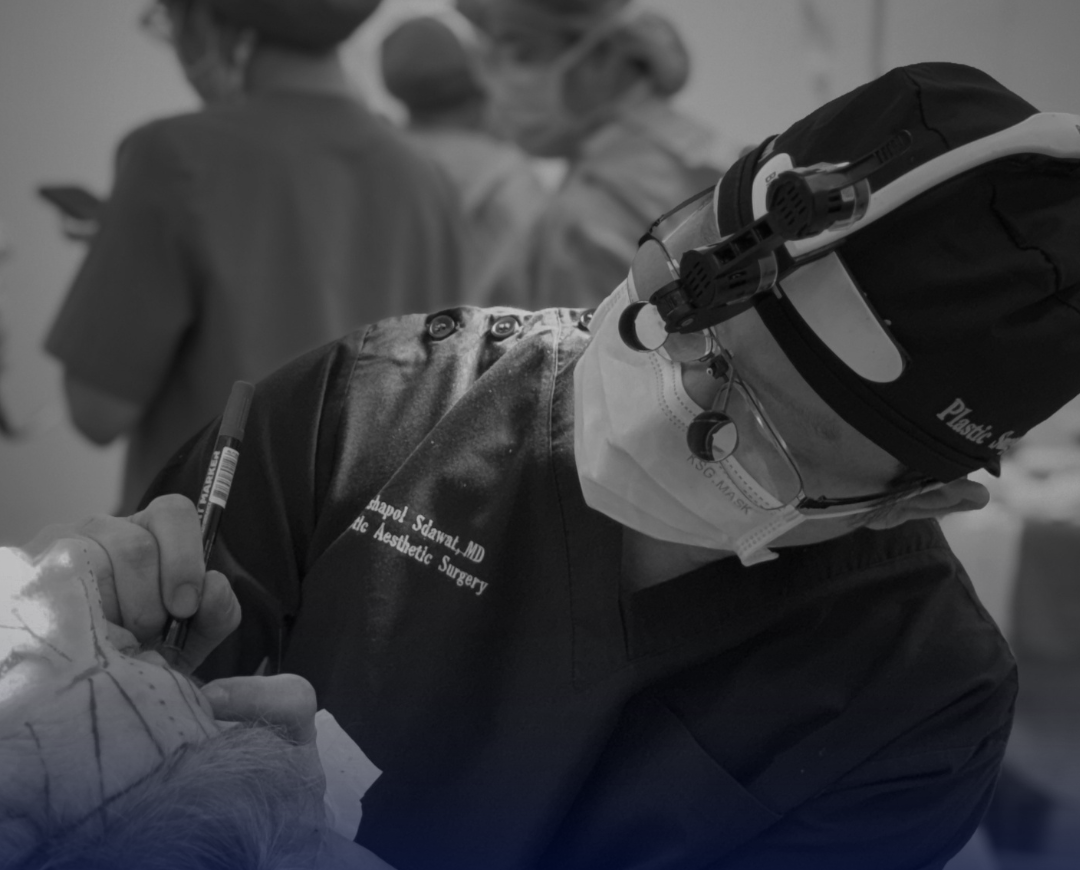
Breast Augmentation in Bangkok
Breast implant surgery performed by Dr. Rushapol Sdawat, M.D., Thai board-certified plastic surgeon, at Intrarat Hospital — with the implant details, risks and long-term follow-up set out in writing before you decide.
Adding volume with an implant — a device that needs lifelong care
Breast augmentation increases the size and changes the shape of the breasts by placing an implant behind each breast, either over or partly under the chest muscle. It suits women whose breasts are naturally small, asymmetric, or have lost volume after pregnancy or weight loss.
Augmentation adds volume but does not lift a breast that has descended. If the nipple sits at or below the breast fold, a breast lift — with or without an implant — is usually the more appropriate operation.
Your operation is performed by the surgeon you consult
Dr. Sdawat measures the chest, breast width, skin stretch and tissue thickness at examination and uses them, together with your goals, to recommend implant size, profile and position — and explains what will not be achievable with your tissues.
- ✓Board-certified in plastic surgery since 2000Diploma of the Medical Council of Thailand certifying proficiency in Plastic Surgery, issued 13 July 2000 · licence No. 17689
- ✓The Society of Plastic and Reconstructive Surgeons of ThailandQualified June 2000 · full member since August 2001
- ✓ISAPS member since 2008International Society of Aesthetic Plastic Surgery
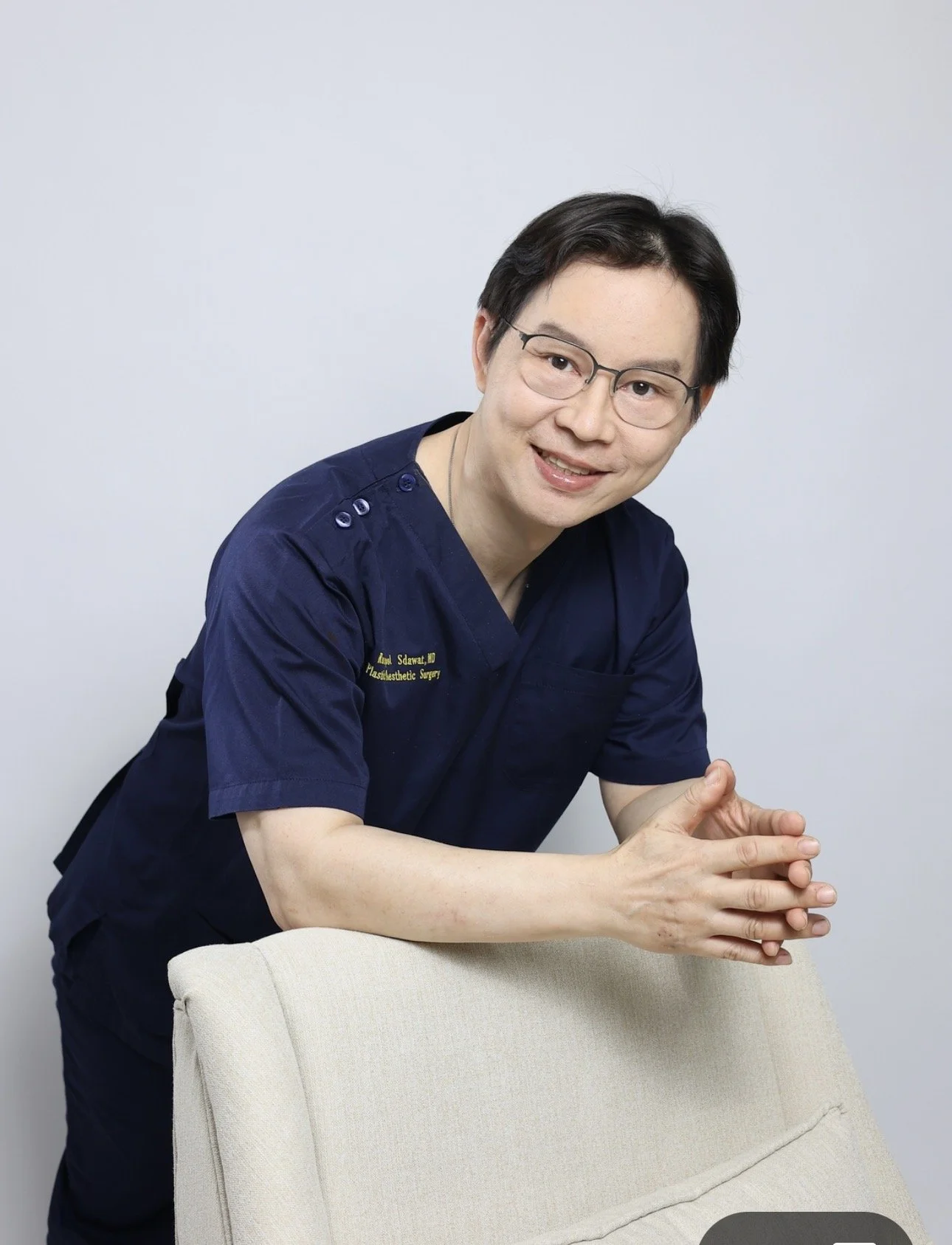 Dr. Rushapol Sdawat, M.D.
Implant, pocket and incision
Each decision has trade-offs. These are discussed at consultation and recorded in your written plan.
| Decision | Options | What to weigh |
|---|---|---|
| Filling | Silicone gel or saline (salt water) | Silicone feels closer to breast tissue and does not collapse if the shell tears, so a rupture can be silent. Saline deflates visibly if it ruptures. |
| Shape | Round or anatomical (teardrop) | Anatomical implants can rotate, which changes the breast shape. The difference in appearance between the two is often small. |
| Surface | Smooth or textured | Smooth implants are softer and can move more freely. Textured surfaces are associated with BIA-ALCL; several highly textured models were withdrawn from the Australian market in 2019. |
| Over the muscle (subglandular) or partly under it (dual plane) | Muscle cover helps where breast tissue is thin. Over the muscle avoids movement of the implant with chest-muscle contraction. | |
| Incision | Breast fold, lower edge of the areola, or armpit | The breast-fold incision gives the most direct access and is the most commonly used. |
Size. Larger implants place more strain on the skin and breast tissue over time and are associated with more stretching, visible rippling and descent. A proportionate size, chosen from your measurements rather than a number of cc, tends to age better.
Fat transfer is an alternative for a modest increase: fat is taken by liposuction from elsewhere and injected into the breast. Some of the fat is reabsorbed, more than one session may be needed, and firm lumps (fat necrosis) can form.
What every patient with implants should know
Implants are not lifetime devices
The US Food and Drug Administration states that breast implants are not lifetime devices. Over the years, implants can rupture, the scar capsule around them can tighten (capsular contracture), and the breast changes with age and weight. Many women have further surgery at some point.
For silicone implants, the FDA recommends imaging for silent rupture — ultrasound or MRI — at five to six years after surgery, then every two to three years.
BIA-SCC
Squamous cell carcinoma in the capsule around an implant has been reported in rare cases with both smooth and textured implants, years after surgery. It usually presents with swelling or pain, which should always be assessed.
BIA-ALCL
Breast implant-associated anaplastic large cell lymphoma is an uncommon lymphoma that forms in the fluid or capsule around an implant. In Australian data, cases have been associated with textured implants, and the risk differs between implant types. It typically appears several years after surgery as a late swelling caused by fluid around one implant, less often as a lump.
Removing implants without symptoms is not recommended for BIA-ALCL prevention. A new swelling, lump or change in shape — at any time — should be examined.
Breast implant illness
Some women report symptoms such as fatigue, joint pain or difficulty concentrating that they attribute to their implants. The cause is not understood, and evidence on whether symptoms improve after removal is mixed.
Who this operation is for — and who it is not for
Suitability can only be determined by consultation and in-person assessment.
A good candidate usually has
- Breasts that are naturally small, asymmetric, or have lost volume after pregnancy or weight loss
- Good general health and a stable weight
- No nicotine — or the ability to stop every nicotine product for the period the surgeon requires
- Breast screening up to date for your age
- An understanding that implants need monitoring and may need further surgery in future
- Realistic expectations about size, shape and scars
Dr. Sdawat will not operate when
- You are pregnant or breastfeeding, or stopped only recently
- A breast lump or abnormal screening result has not been investigated
- There is active infection anywhere in the body
- Nicotine cannot be stopped — cigarettes, vaping, patches or gum reduce blood supply to the skin and nipple and raise the risk of wound breakdown
- Blood pressure or diabetes is uncontrolled, or there is a bleeding disorder or anticoagulant that cannot be safely paused
- Heart, lung or kidney disease makes a general anaesthetic unsafe
- The breast has descended so that a lift is needed to achieve the goal
How it is performed
The planned incision and implant position are marked with you standing. Under general anaesthesia, a pocket is created behind the breast tissue (and, in the dual-plane position, partly behind the pectoralis muscle). Sizers may be used to confirm the volume before the final implants are placed. The incisions are closed in layers and a surgical bra is fitted.
Anaesthesia
General anaesthesia given by a hospital anaesthetist from Intrarat Hospital's anaesthesia department, with continuous monitoring.
Operating time
Typically one to two hours, longer if a lift or other procedure is combined.
Hospital stay
Usually one night in hospital before transfer to recovery accommodation.
Surgery in a full hospital, not a clinic
Intrarat Hospital, Bangkok: operating theatres, its own anaesthesia department and an intensive care unit, certified ISO 9001:2015.
A hospital anaesthetist gives the general anaesthetic and stays with you throughout the operation. Overnight nursing, and — if it is ever needed — a return to theatre or intensive care, are available in the same building.

What actually happens, week by week
Recovery varies between individuals; this is a general guide only.
Day 0–1 · Hospital
Chest tightness and soreness, more so when the implant is under the muscle. Surgical bra on; walking the same day.
First week
Swelling settles gradually. No lifting or reaching overhead. Light desk work is often possible after about a week.
Days 10–14 · Review
Wound check and surgeon review before clearance to fly.
Weeks 3–6
Supportive bra day and night for the period Dr. Sdawat advises — often several weeks. No heavy lifting for at least a month; exercise resumes in stages.
Months 3–12
The implants settle lower and soften over several months. Scars fade over 12 to 18 months.
All surgery carries risk. These are the recognised ones.
- Bleeding or haematoma, which may need a return to theatre
- Infection, which may require removal of the implant
- Capsular contracture — tightening of the scar capsule, causing firmness, distortion or pain
- Implant rupture or leakage
- Implant malposition, rotation or visible rippling
- Change in nipple or breast sensation
- Asymmetry
- Thickened or widened scars
- Reduced ability to breastfeed
- BIA-ALCL and, rarely, BIA-SCC (see above)
- Symptoms some women attribute to implants (breast implant illness)
- Blood clots in the legs or lungs (DVT or pulmonary embolism)
- Risks of general anaesthesia
- Further surgery to replace or remove implants in future
A written, itemised quotation — not a package price
The cost of breast augmentation in Bangkok depends on the implants chosen, whether a lift or other procedure is combined, the length of hospital stay, and the anaesthetic and hospital fees involved. The quotation names the implant manufacturer, type, surface and size. A written, itemised quotation is provided after Dr. Sdawat has reviewed your photographs and history, so that the price reflects the operation you actually need.
The quotation lists the surgeon's fee, anaesthetist, hospital stay, operating theatre, garments and follow-up. Return flights, a companion's travel and travel insurance are separate. Prices are quoted in Thai baht.
From video consultation to clearance to fly
Video consultation
Begins by video with photographs. Dr. Sdawat reviews your history and photographs before any plan is made.
Assessment in Bangkok
In-person examination, blood tests and an anaesthetic assessment before surgery. Surgery is confirmed only after that assessment.
Review before flying
You stay in Bangkok for post-operative reviews and fly only when Dr. Sdawat has cleared you.
Answered plainly
Do breast implants last for life?
No. Breast implants are not lifetime devices. Many women need further surgery at some point — to replace or remove an implant, or to treat capsular contracture, rupture or a change in the breast. The timing varies widely, so it is sensible to plan for it rather than assume a fixed number of years.
Which implants are used?
Your written plan names the implant manufacturer, type (silicone gel or saline), shape, surface and size. You receive the implant card with the model and lot numbers. Keep it — surgery performed overseas is not recorded in the Australian Breast Device Registry, and these details matter if you ever need care at home.
What is BIA-ALCL?
Breast implant-associated anaplastic large cell lymphoma is an uncommon cancer of the immune system that develops in the fluid or scar capsule around an implant. It has been linked mainly to textured implants, usually appears years after surgery, and most often shows as a sudden swelling of one breast. Any late swelling should be assessed.
Can I breastfeed with implants?
Many women breastfeed after augmentation, but some have reduced milk supply or nipple sensation. If breastfeeding matters to you, raise it at consultation, as incision and pocket choice can be relevant.
Will I need scans after surgery?
For silicone implants, the US Food and Drug Administration recommends a first ultrasound or MRI to check for silent rupture five to six years after surgery, then every two to three years. Tell your GP and breast screening service that you have implants.
How long do I stay in Bangkok?
Plan for around 10 to 14 days: usually one night in hospital, then recovery accommodation nearby with a review before Dr. Sdawat clears you to fly.

Start with an assessment, not a booking
Send your photographs and history for review by Dr. Sdawat. A consultation is an assessment — not a commitment to surgery.
All surgery carries risks. Individual results vary from person to person and are not guaranteed. A consultation and assessment with your surgeon is required before any procedure. This page is general information and does not replace a consultation. Surgery is performed by Dr. Rushapol Sdawat, M.D., Thai Board-Certified Plastic & Reconstructive Surgeon, Medical Council of Thailand licence No. 17689, at Intrarat Hospital, Bangkok.
