

The honest answer is that nobody can give you a date before they have assessed you
The honest answer is that nobody can give you a date before they have assessed you
The question I am asked more than any other, usually before a patient has sent me a single photograph, is: how many days off work do I need?
I understand why. You cannot book a flight without a date, you cannot ask for leave without a number, and every agency website has a tidy figure sitting in a coloured box. But the figure in the coloured box is a marketing estimate, not a clinical one. Your length of stay in Bangkok is decided by five clinical milestones, and those milestones happen when your tissue says they happen — not when your return flight says they should.
What I can give you is the structure. If you understand what has to be finished before you fly, you can plan around it honestly, build in the contingency, and stop guessing.
The five milestones that actually set your date
Every plan I write for an overseas patient is built backwards from these. They are the same for a facelift and for a tummy tuck; only the timing shifts.
1. The first dressing change and wound inspection. This is the first look at whether the wound is behaving. Nothing else in the plan can be confirmed until it has happened.
2. Drain removal, where drains are used. Drains come out on output, not on a calendar. Abdominoplasty and large-volume body work are the usual reasons a patient stays longer than they expected — drains that are still producing are a clinical reason to keep you here, and no reputable surgeon will pull them early because you have a flight.
3. Suture or staple removal, or confirmation that dissolvable material is settling correctly.
4. The final in-person review. The point of travelling to a surgeon is that the surgeon sees the result with their own eyes before you leave. A video call three days later is not the same examination.
5. Fitness-to-fly assessment. This is a separate decision from "are you healing well". It is about whether a pressurised cabin and eight to eleven hours of immobility are safe for you specifically. I have written about the evidence on this separately, because it deserves its own article, and because most of what is published online about it is wrong.
The airline's rules are not your surgeon's rules
This trips up more patients than anything else, so it is worth being precise. Airlines publish minimum thresholds for carriage. Those are the point below which the airline will not fly you at all. They are a floor, not a recommendation.
Qantas, in its Group Medical Travel Clearance Guidelines (QMS 300 V5, December 2022), lists plastic surgery to superficial tissues, and breast augmentation or reduction, as unsuitable for travel within 24 hours, with a medical clearance form required within two to four days. Open abdominal surgery — through a full incision rather than keyhole — is listed as unsuitable within 10 days, with clearance required at 11 to 14 days. Air New Zealand's doctor guidelines (MEDA Part 3, June 2020) set major abdominal procedures at 10 days or more post-operatively for an uncomplicated recovery. The UK Civil Aviation Authority advises that travel be avoided for 10 days following abdominal surgery.
Note what Qantas does not do: it does not classify abdominoplasty explicitly. A tummy tuck is not a superficial-tissue procedure, and treating a 24-hour airline threshold as clearance to fly home after one is a misreading of the document. When there is doubt, the conservative row is the correct row.
And note what nobody publishes. No plastic surgery college in Australia, New Zealand, the United Kingdom or the United States publishes a fixed number of days to wait before flying after cosmetic surgery. Not the Australian Society of Plastic Surgeons, not ASAPS, not RACS. If you read "wait seven days" somewhere, that number came from a clinic or a blog, not from a professional body. New Zealand's own government travel service puts it plainly: "Flying after surgery may increase the risk of deep vein thrombosis, seek advice from your health practitioner before you fly."
What a realistic itinerary looks like
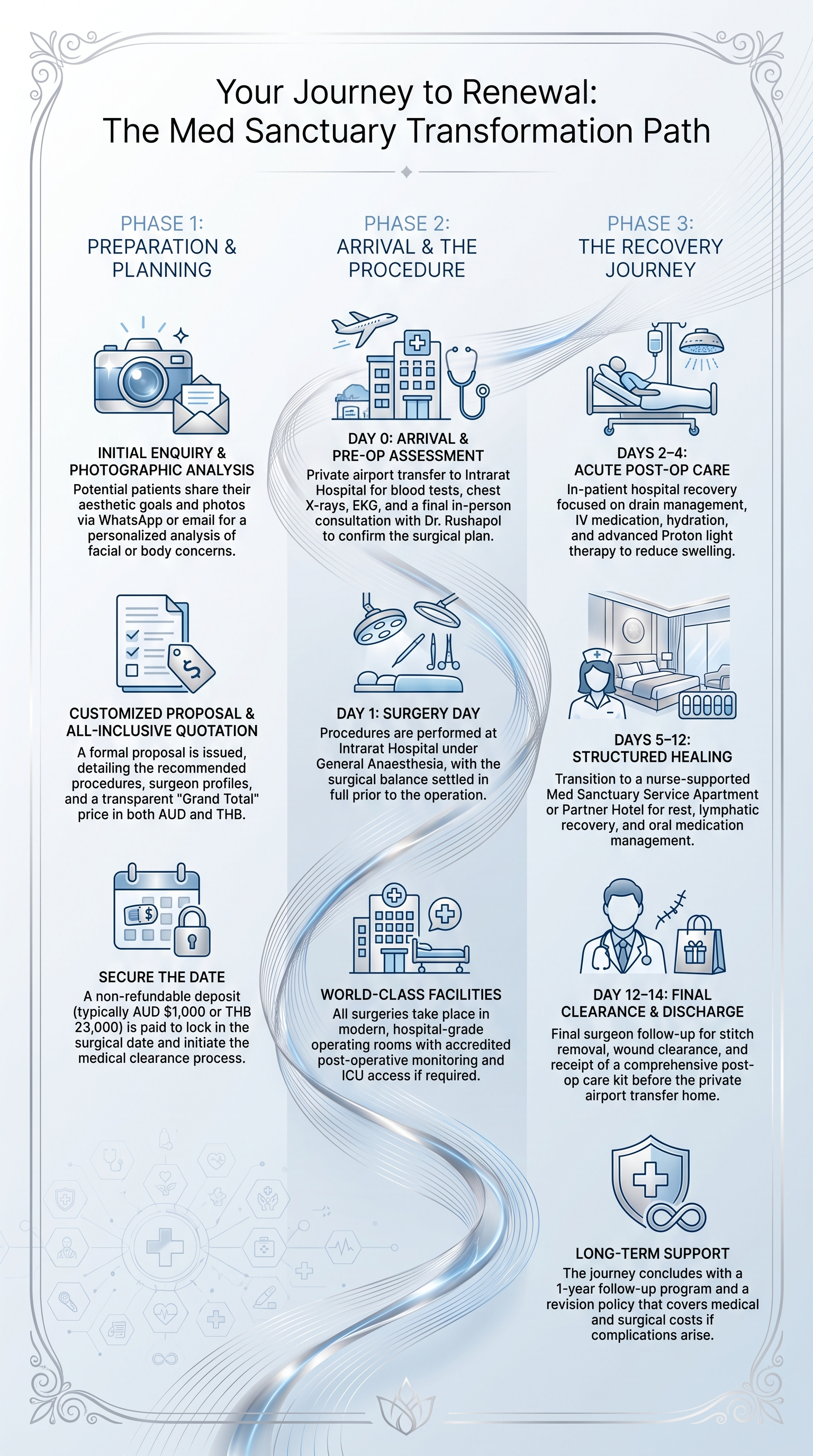
Here is the shape of the trip, described in relative days rather than absolute ones, because your absolute dates come from your surgeon after assessment.
Arrival, two to three days before surgery. Not the night before. You need to be over the flight, sleeping on local time, and available for the in-person consultation, pre-operative bloods and any imaging. This is also the last honest opportunity for either of us to change the plan or call it off. If a provider is willing to operate on you the morning after you land, having only ever seen photographs, that tells you something about the provider.
Surgery day. Expect to be at the facility for the day regardless of whether you stay the night. Whether you are admitted overnight depends on the procedure and the anaesthetic, and it depends on the facility being legally permitted to admit you at all — under Thailand's Sanatorium Act B.E. 2541, facilities are divided into those that may keep patients overnight and those that may not. A day clinic cannot legally admit you.
The first 48 to 72 hours. This is the window where complications declare themselves — bleeding, haematoma, an airway or pain-control problem. You want to be close to the surgical facility, not out at a beach resort. Walking short distances begins early; this is standard advice after liposuction specifically because early mobilisation reduces swelling and clot risk.
The middle stretch. Dressing changes, drain checks, sleeping upright if the procedure requires it, and the dull, unglamorous work of not doing very much. Patients consistently under-estimate how boring this part is and over-estimate how much sightseeing they will do.
The final review and the fit-to-fly decision. Then, and only then, the flight home is confirmed.
What the packages advertise — and how to read those numbers
Bangkok providers do publish total-stay figures. They are worth knowing, as long as you read them as advertised inclusions rather than clinical standards.
One Bangkok recovery service, Beauty Butler Thailand, publishes a recommended total time in Thailand of around 8 to 12 days for facial surgery (rhinoplasty, facelift, eyelid), around 10 to 14 days for body surgery (tummy tuck, liposuction), and around 12 to 16 days for combined procedures. Another, Amani Thailand, structures its published packages at 10 to 14 days total for a mommy makeover, 13 days for a facial package, and 21 days for a larger body package.
Two observations. First, these are commercial operators describing their own products, not a professional consensus. Second — and this is the useful part — even the marketing does not claim you can do this in a long weekend. When the people selling the trip say ten to fourteen days, treat anything shorter with suspicion.
The risk window does not close when the wheels touch down
The World Health Organization's WRIGHT project found that the risk of venous thromboembolism approximately doubles after travel of four hours or more, that the absolute risk remains relatively low at about 1 in 6,000, and — the part that matters most for surgical patients — that "the risk of VTE does not go away completely after a flight is over, and the risk remains elevated for about four weeks."
The UK's National Travel Health Network lists recent surgery of more than 30 minutes' duration, performed four weeks to two months previously, as a travel VTE risk factor in its own right. Its prevention advice for flights over four hours is unglamorous and effective: walk at regular intervals, flex and extend the ankles regularly, keep the footwell clear of hand luggage, avoid constrictive clothing at the waist and legs, and, for higher-risk travellers, properly fitted below-knee graduated compression socks delivering 15 to 30 mmHg at the ankle. Low molecular weight heparin may also be recommended.
Plan the flight home the way you would plan the surgery: aisle seat, water, movement, compression, and a low threshold for presenting to a hospital if you develop calf pain, breathlessness or chest pain in the weeks afterwards.
Two things that will extend your stay, and one that should
Drains that keep producing, and a wound that is not closing cleanly. Neither is unusual, neither means something has gone wrong, and both are reasons to change the flight rather than the treatment.
The third is judgement. If your surgeon tells you to stay longer and you feel financial pressure to fly, that pressure is exactly what the contingency in your budget is for. If your budget has no contingency in it, the budget is not finished.
Your visa will probably allow more time than you have booked — check anyway
Australian and New Zealand passport holders can currently enter Thailand visa-free for up to 60 days, and Smartraveller notes a limit of two visa-free entries per calendar year without a justifiable reason. A visa-exempt stay can generally be extended once, by 30 days, at a provincial immigration office, at the discretion of the immigration officer.
Do not treat that 60 days as permanent. On 19 May 2026 the Thai Cabinet approved a reduction of visa-free stays to a tiered system capping most nationalities at 30 days. The Tourism Authority of Thailand confirmed in July 2026 that the measures are pending publication in the Royal Gazette and take effect 15 days after publication. As at August 2026 the change had not commenced, and travellers who enter before it does keep the duration of their existing permitted stay. Check the position at the time you book, not at the time you read this.
For longer treatment there are dedicated routes: a Tourist "MT" visa for medical treatment (up to 60 days) and a Non-Immigrant "O" for medical treatment (up to 90 days), the latter requiring a letter from the Thai hospital confirming treatment duration of more than 60 days. Separately, every non-Thai national entering by air, land or sea must complete the free Thailand Digital Arrival Card online within three days before arrival. The only official site is tdac.immigration.go.th. Anything charging you a fee for it is not the government.
The one question to answer before you book the flight home
Not "when can I fly?" but "who decides?"
If the answer is your surgeon, after examining you, you have a plan. If the answer is a booking confirmation you paid for eleven weeks ago, you have a deadline — and deadlines are how people end up boarding aircraft they should not be on.
By Dr. Rushapol Sdawat, MD — Thai Board-certified Plastic and Reconstructive Surgeon, Medical Licence No. 17689. You can verify my registration and specialty directly with the Medical Council of Thailand at tmc.or.th.
This article is provided for general information and education. It is not medical advice and cannot substitute for individual assessment by a qualified practitioner who knows your history. Surgery carries risk, including risk of serious complications and of outcomes that do not meet expectations. Results vary between patients.
Sources: Qantas Group Medical Travel Clearance Guidelines QMS 300 V5 (December 2022); Air New Zealand MEDA Part 3 Doctor Guidelines (June 2020); UK Civil Aviation Authority, guidance for health professionals — surgical conditions; World Health Organization WRIGHT Project (29 June 2007); NaTHNaC/TravelHealthPro VTE factsheet; SafeTravel New Zealand, Medical tourism; Smartraveller, Thailand; Tourism Authority of Thailand (16 July 2026); Royal Thai Embassy medical visa pages; Sanatorium Act B.E. 2541.

