
Thread lift vs facelift: what threads can and cannot do

When patients ask me about a thread lift vs facelift, the honest short answer is that they are not competing treatments. A thread lift is a minor, temporary procedure that can give a subtle improvement in a face with mild early sagging. A facelift is an operation that repositions the deep structures of the face and neck and gives a change that lasts years. One is not a smaller version of the other. They do different things, for different faces, and the most common mistake I see is a patient having threads when their face needed surgery, or being sold surgery when threads or nothing at all would have been sensible.
I am a facelift surgeon, so you might expect me to be dismissive of threads. I am not. In the right patient, at the right age, a PDO thread lift can be a reasonable choice, and I would rather you understood exactly what you are buying. What I object to is the phrase "non surgical facelift", which promises a result threads cannot deliver.
This article explains how threads work, what results are realistic, how long a thread lift lasts, and how I decide whether threads or a facelift is the right recommendation.
How a thread lift works
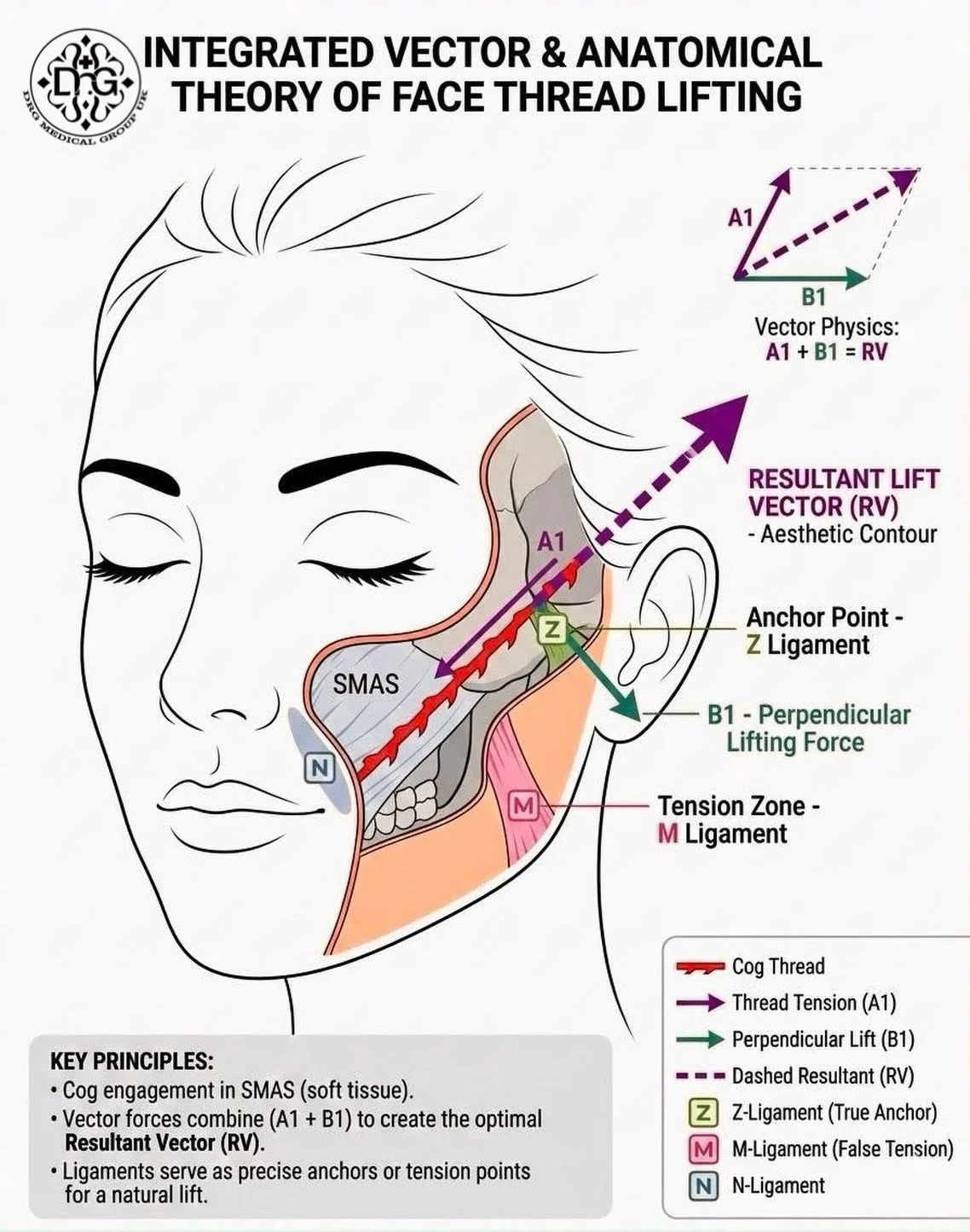
A thread lift uses fine, dissolvable sutures inserted under the skin through a needle or cannula. The most common type is PDO (polydioxanone), a material used in surgical stitches for decades that the body breaks down over several months. Other materials, such as PLLA (poly-L-lactic acid) and PCL (polycaprolactone), dissolve more slowly.
Lifting threads have tiny barbs or cones along their length. Once placed, the practitioner pulls gently so the barbs catch in the tissue and hold it slightly higher. The procedure is done under local anaesthetic, takes under an hour, and the patient goes home the same day.
Two things happen. First, an immediate mechanical lift, held by the barbs. Second, over the following weeks, the body lays down collagen around the thread, giving mild firming. This is what "collagen stimulation" from threads means.
What a thread lift can realistically do
A PDO thread lift is best suited to a fairly narrow group: patients typically in their late thirties to early fifties with good skin, mild early jowling or softening of the jawline, and no significant neck laxity. In those patients, threads can:
Give a subtle lift to the mid-cheek and jawline, of the order of a few millimetres.
Slightly sharpen the jawline in a face that is only beginning to soften.
Provide a modest, temporary firming of the skin from the collagen response.
Be done with minimal downtime, usually a few days of swelling and some bruising.
That is a real benefit for the right person, but a small one. If you are hoping for a noticeable change in photographs, threads will usually disappoint.
What a thread lift cannot do
This is the more important list, because it is where expectations go wrong.
Threads cannot lift heavy or advanced sagging. The barbs hold a small amount of soft tissue. They cannot support established jowls, deep folds beside the nose or a heavy lower face. Pull hard enough to move that much tissue and the threads tear through or create visible puckering.
Threads cannot treat the neck. Loose neck skin, vertical bands (caused by the platysma, the thin sheet of muscle under the neck skin, becoming lax and separating) and a heavy "turkey neck" all need surgery. Threads in the neck have a poor track record. See my article on neck lift in Bangkok.
Threads cannot remove excess skin. Once skin has stretched, there is more of it than the face needs. A thread can bunch it slightly; only surgery can remove it.
Threads do not reposition the deep structures. The ageing that makes a face look tired is mostly in the SMAS (the fibrous and muscular layer beneath the skin of the cheek) and the fat compartments on it. A deep plane facelift releases and repositions this layer. Threads only tug on the tissue just under the skin.
Threads cannot last. This deserves its own section.
Thread lift: how long does it last?
A thread lift's results are temporary. The threads dissolve over roughly six to twelve months, depending on the material, and the mechanical lift fades before that as the barbs loosen. Most practitioners describe the visible lift as lasting around a year, sometimes a little more with slower-dissolving materials, with some residual firmness persisting beyond that.
A patient who wants to maintain the effect must therefore repeat the procedure every year or two. Over a decade that is a meaningful cost, and each time the face has aged a little further, until threads simply no longer hold enough.
By comparison, a well-performed deep plane facelift is generally expected to hold its improvement for many years; I discuss this in how long does a deep plane facelift last.
Thread lift vs facelift: side by side
PDO thread liftDeep plane faceliftWhat it treatsMild early sagging of cheek and jawlineModerate to advanced sagging of face and neck, jowls, deep folds, neck bandsAnaesthesiaLocalGeneral anaesthesia or deep sedation, in hospitalProcedure timeUnder one hourSeveral hoursDowntimeA few days of swelling and bruisingAround two weeks before looking presentable; several weeks to settleScarsNone visible (needle entry points)Fine scars hidden around the ear and hairlineDuration of resultRoughly one year, sometimes a little moreMany yearsTreats the neck?NoYes, especially when combined with platysmaplastyRemoves excess skin?NoYesTypical patientLate 30s to early 50s, good skin, minimal laxity45 and over, with established laxityComplicationsPuckering, visible or palpable threads, asymmetry, infection, thread migrationHaematoma, temporary nerve weakness, scarring, skin healing problems (all uncommon in experienced hands)
The risks of thread lifts are real, not trivial
Because a thread lift is marketed as minor, its complications are often glossed over. I see patients who have had them, and the problems are recognisable.
The most common is puckering or dimpling where a barb has caught too close to the surface; this usually settles but can persist. Threads can become visible or palpable as a ridge under thin skin, particularly in the temple. Asymmetry is common because the two sides rarely respond identically. Infection along the thread track can require removal, and threads can migrate.
Less discussed is what happens later. Scar tissue forms along every thread track. When a patient who has had several rounds of threads comes to me for a facelift, the tissue planes are stuck together with fibrous bands, and the dissection is slower and less predictable. It does not prevent surgery, but it makes it harder.
Where non-surgical treatments genuinely help
I want to be fair to non-surgical options, because they have a sensible role. Skin treatments such as laser, skin needling and prescription skincare improve texture and pigment that no facelift addresses. Fillers can restore volume in the temples, cheeks and around the mouth, though they are temporary and can look heavy if overused. Anti-wrinkle injections soften lines of expression.
In a patient with early ageing these can delay the point at which surgery is needed, and they remain useful after a facelift. What they cannot do, individually or together, is provide a "non surgical facelift". Nothing non-surgical repositions the deep structures of the face or removes loose skin. I would rather you heard that from a surgeon than learned it after spending a good deal of money.
Thread lift vs facelift: how I decide
When I assess a patient, I am looking at four things.
The degree of laxity. I ask the patient to lean forward and look in a mirror, which shows the true extent of sagging. If the jowls and neck are clearly established, threads are not an option.
The neck. If there is meaningful neck laxity or banding, surgery is the only treatment that will make a difference, and threads in the face while ignoring the neck produce an unbalanced result.
Skin quality. Thin, sun-damaged skin shows threads and puckers easily. Thicker skin tolerates them better but needs more support than they can give.
Age and timeline. A patient in their early forties with minimal laxity who is not ready for surgery is a reasonable thread candidate, provided they understand the result is subtle and temporary. A patient in their late fifties asking whether threads could "put off" a facelift is usually better advised to do nothing until they are ready for surgery, rather than spend on repeated procedures that will not satisfy them. My thoughts on timing are in best age for a facelift.
I do not offer thread lifts myself and have no financial interest in whether a patient has one. I mention this so you can weigh my view accordingly.
A note for Australian and New Zealand patients
In Australia, thread lifts are widely available in cosmetic clinics. Some patients tell me they were offered threads as a "non surgical facelift" without any discussion of surgery as an alternative. Since 1 July 2023, Australians need a GP referral before a cosmetic surgery consultation, and that visit is a good opportunity for an independent view on whether threads can address your concerns at all.
For patients weighing surgery in Thailand against threads at home, see my facelift in Thailand guide for Australians and New Zealanders. Medicare does not cover purely cosmetic procedures of either kind, and Australian travel insurance generally excludes elective cosmetic surgery abroad.
Frequently asked questions
Is a thread lift as good as a facelift?
No. In any honest thread lift vs facelift comparison, the difference is scale and durability. A thread lift gives a subtle, temporary lift of a few millimetres in a face with mild early sagging. A facelift repositions the deep structures, removes excess skin, treats the neck and lasts many years. They are different procedures for different degrees of ageing.
How long does a PDO thread lift last?
The visible lift usually lasts around a year, sometimes a little longer with slower-dissolving materials. The threads themselves dissolve over roughly six to twelve months. Maintaining the effect means repeating the procedure regularly.
Can a thread lift delay the need for a facelift?
In a patient with very mild early sagging, it may provide a temporary improvement while they decide about surgery. It does not slow the ageing process, and repeated threads leave scar tissue that can make a later facelift more difficult.
Can I have a facelift after a thread lift?
Yes. Old threads are usually dissolved or can be removed during surgery. The scar tissue they leave makes the dissection slower, but it does not prevent a good result in most patients.
What are the main risks of a thread lift?
Puckering or dimpling of the skin, visible or palpable threads, asymmetry, infection, and thread migration. Most are minor but some require the threads to be removed.
Who should not have a thread lift?
Anyone with established jowls, significant neck laxity or excess skin, very thin sun-damaged skin, or expectations of a dramatic change. Those patients need either surgery or a frank conversation about doing nothing for now.
This article is general information, not medical advice. The right choice between threads, surgery or no treatment depends on your face, your age and your goals. If you would like an honest assessment of whether a thread lift or a facelift suits you, you are welcome to book a video consultation with me.
